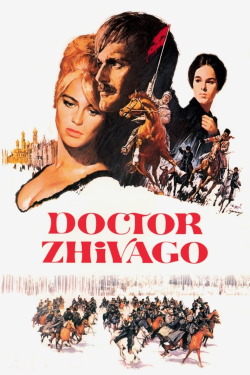
Review of Doctor Zhivago (1965) by Cinema F — 26 Mar 2009
Few directors would always get international audience.
And when one considers the positive public response to many of David Lean's films, it is just fair to say that only few directors have commanded such a large portion of the mass audience.
Working again with his screenwriter Robert Bolt, Lean's epic film Doctor Zhivago could be described as " a fateful series of brief encounters.".
The complicated narrative is held together by a series of connecting and associative images--moon, windows, candles, cornflowers and daffodils to suggest the two women in Zhivago's life.
Doctor Zhivago (Omar Shariff) is the idealistic doctor hero swept along by the epic events of the Russian Revolution in Bolt's adaptation of Boris Pasternak's Nobel Prize-winning novel. Banned in the Soviet Union but acclaimed in the West, the novel is a about the story of love and a great documentary of the Bolshevik Revolution.
The lovers are Zhivago and the beautiful, sensual Lara (Julie Christie), for whom a brief happiness is tragically engulfed by the tide of history. There is a stunning last shot of Lara, as she disappears alone down a grey street that is dominated by a huge red poster of Stalin.
It is an image that crystallizes the theme of the individual and the state, as well as implicitly asking questions that are at the heart of Dr Zhivago--what the revolution was for, where it led, and, whom it affected.
Again, Director Lean has approached this film with his customary deliberation and meticulous preparation.
Inasmuch as some critics found the flick to be something of a disappoinment, it's a film with stunning cinematography, good script, and talented people behind it.
This review of Doctor Zhivago (1965) was written by Cinema F on 26 Mar 2009.
Doctor Zhivago has generally received very positive reviews.
Was this review helpful?