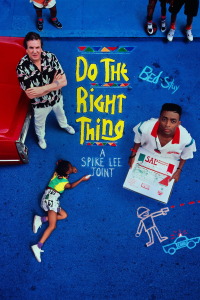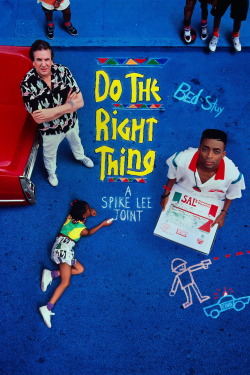
Review of Do the Right Thing (1989) by Jake W — 23 Jun 2011
Both the initial reason why Spike Lee is a household name and one of the most controversial films of all time, Do the Right Thing is a masterwork, and one of the greatest films of the past 30 years. It's a truly startling and affecting portrait of a day in a Bed-Stuy neighborhood in Brooklyn, New York during the late 1980s and early 1990s, one which genuinely reveals and honestly understands the state of race relations in the United States at the time (and things haven't changed much in the 22 years since its release). Like all great films, Do the Right Thing exists in shades of grey, with no blame placed on an individual person for the events that transpire throughout the film. It isn't preachy, and it doesn't give any answers, nor does it act like it knows the answer. It simply sets you down in this neighborhood and lets the characters interact with each other, telling a story that is brutally honest and completely free of melodrama or manipulation. Watching Do the Right Thing is frustrating and aggravating in a way that so few films are, and it is a film that has the power to really cause one to sit and think. The day depicted in the film isn't one that the residents of this neighborhood will forget, and it isn't one that is easy to forget for a viewer either.
The movie centers around one very hot day in summer (I assume 1989) in a predominantly black Bed-Stuy neighborhood in Brooklyn. The characters that populate the neighborhood include Mookie (Spike Lee) a pizza delivery boy for Sal's Famous Pizzeria, his sister Jade (Joie Lee, Spike's real-life sister), and Tina (Rosie Perez), Mookie's girlfriend. The lone white business on the block is Sal's, owned by Sal (Danny Aiello) and his two sons, blatant racist Pino (John Turturro) and Vito (Richard Edson), who is unperturbed by skin color. There's also Radio Raheem (Bill Nunn), who wanders around the street all day with a large boom box blasting rap music, Buggin' Out (Giancarlo Esposito), an activist who wants Sal to put some famous blacks up on his wall of famous Italian Americans, Smiley (Roger Guenveur Smith), a mentally disabled man who walks around talking about Martin Luther King Jr. and Malcolm X, Da Mayor (Ossie Davis), an elderly drunk, and Mother-Sister (Ruby Dee), the woman being courted by Da Mayor. Presiding over the street is Mister Señor Love Daddy (Sam Jackson), who never leaves his radio booth but still finds time to make keen observations about the street and its inhabitants outside.
For the first three fourths of the film, Do the Right Thing is a very compelling drama that succeeds based on the strength of the honesty of the character's personalities and the cleverness of Lee's directing. In terms of scripting, this is genuinely involving material with characters that feel all-too-real. Their interactions convey honesty, and every character, even Mookie, is genuinely flawed and complex. Even characters you would think would be cookie-cutter villains are wisely treated with a degree of understanding. Pino, for example, is both wisely underplayed by John Turturro and given a complexity usually not afforded to such blatant racists on film. He's not sympathetic by any means, but the film plays his character as more flawed than evil, and this gives the movie an added level of depth by reminding us that prejudices aren't cartoonishly evil problems but things that actual human beings unfortunately believe in.
Likewise, the character of Sal represents the even more subtle side of racism, the side that much of white America (according to Lee) is on. Sal is entirely willing to live with and even friendly to blacks on the surface, and he clearly has a genuine appreciation for them and their love of his food, but deep-down there are shades of a darker side. He doesn't hate blacks, but there are subtle hints that he isn't immune to thinking in stereotypes. The movie plays this character in a way that makes us unsure of whether he is really racist or not, and it shows us that racism can still exist in more subtle ways. People who are nice, caring individuals can still hold and maintain stereotypes and biases even though they do genuinely believe whites and blacks can get along and live together.
However, Do the Right Thing doesn't lay the blame on whites. Every character is flawed, with Buggin' Out storming into Sal's pizzeria and criticizing Sal in an arguably disrespectful way, Radio Raheem rudely refusing to turn off his radio early on in the film upon entering Sal's, and even Mookie taking time off from work during the middle of his day to take a shower and spend time with his girlfriend. Throughout the course of the film, every character at times fails to do the right thing, and because of this, the movie has a genuine honesty about it that most films of this nature lack.
The last half hour of the film is uncompromising, shocking, and heart-breaking in its depiction of what happens when human flaws, slowly simmering racial tension, and the scorching heat of the day combine to bring the conflict to a visceral climax. By the end of the film, everything has changed for this block. The events that have transpired will not be forgotten by anyone that has witnessed them, and everyone that is more directly affected will still hold mental scars of the events that have transpired. The manner in which Lee depicts this event is entirely capable of creating the same effect on the film viewer, and it is entirely free of melodrama or preaching.
All the performances are solid, with Danny Aiello giving us a complex, layered, and very human character that strays far away from becoming a one dimensional antagonist, Sam Jackson turning in an entertaining and forceful performance as the radio DJ whose observations function as semi-narration, Ossie Davis and Ruby Dee turning in respectable work as the eldest characters on screen, and John Turturro and Bill Nunn providing the requisite intensity to make both the characters real presences (although Turturro is given more chances to turn some of that intensity into outright anger when he speaks his mind). Spike Lee is actually the movie's weakest link in the acting department, although he is solid none-the-less. His work behind the camera is stellar though, where he imbues the movie with a sense of style that, like the script, grips our attention. The movie's Public Enemy-infused opening and the attention-grabbing and stylized close-ups of some of the characters (such as when Radio Raheem explains the duality of the world between love and hate) as they speak their minds are particularly notable examples of Spike Lee's directorial flourishes at work.
The main reason why Do The Right Thing is so powerful, so memorable, and so affecting is that it is a movie with something to say, but it isn't a message movie. When the movie is over, viewers are well aware of the problem, but they don't necessarily have an answer. Lee knows the problem is too complex for that, and the movie's goal is never to give you an easy way to interpret the events or an easy explanation for why they happened. Could the events of the film have unfolded differently? We'd like to think so, but Lee's approach really forces us to think exactly how complex this problem is, how many view points and people are involved and affected, and how different people do things for different reasons. Do the Right Thing has something big to say, and it shows us it with all the legitimate honesty and finesse of a masterwork, rather than preaching to us so we can all feel better about ourselves now that we have become enlightened. Roger Ebert wrote in his review of Do the Right Thing that it "comes closer to reflecting the current state of race relations in America than any movie of our time". This still holds true today, and, ultimately, this is why Do the Right Thing is both one of the most important and one of the greatest films of the past 30 years.
Rating: 10/10.
This review of Do the Right Thing (1989) was written by Jake W on 23 Jun 2011.
Do the Right Thing has generally received very positive reviews.
Was this review helpful?