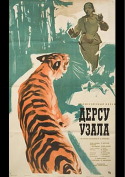
Review of Dersu Uzala (1961) by Snehil B — 01 Jan 2009
1902: Arseniev (Yuri Solomin), a czarist officer and his men exploit and map the Usuri-region. The gigantic pine-forests of the Taiga evoke visions of the Walpurgis-night. Dersu Uzala (Maxim Munzuk) sits down at their camp-fire and smokes his pipe. The old man who lost his wife and children during a smallpox epidemic lives in the mountains without permanent refuge and hunts the stag, the wild boar, the sable. He benefits from the nature but does not exhaust it. As a matter of course he takes the lead of the expedition, shows them how to cover a roof with bark and instructs them to leave stock - rice, salt, matches - for other travelers. They learn not to squander cartridges and that an empty bottle is valuable in the wilderness. They wade through the morass and suddenly the winter sets in.
Arseniev and Dersu lose their way on the ice-covered lake Hanka and the snow-drift covers their footprints. Their race against time is perhaps the most breathtaking scene in the film: the men cut as many blades of grass as possible in order to survive the cold night. Arseniev realizes how small man is in front of the big nature. He invites Dersu to join him ("It' comfortable in the city") but he prefers his free life. He sees the men off to the train station and they agree: " He is such a good man!".
1907, spring, snow-break: Arseniev explores the Usuri-region again. Three months later a vast territory has been mapped, but the task would be carried through quicker with Dersu's help. Arseniev looks out for his old friend: Dersu made much money with furs but a trader disappeared with his savings.
The Taiga in summer is a jungle. "Amdar" (the tiger) follows them. They discover pitfalls with carrion; Dersu is shocked over their needless death. He is at war with the Chunchuse who abduct women. Arseniev helps him save three of their victims who were nearly drowning, but Dersu falls in a torrential river and the rescue-operation is another absorbing (and ingenious) moment in the film.
The turning point in Dersu's life comes when he inadvertently kills the tiger. He becomes nervous and irritable and fears that the spirit "Kangar" will punish him. His vision becomes defective; he misses his game. "How can I live in the Taiga?". Arseniev invites him to Chaberowsk: "My house is your house". His wife welcomes Dersu in their house and his little son worships him, but Dersu cannot manage life in the city where water and wood cost money; He is arrested when he tries to fell a tree...He feels redundant and decides to return to the mountains. Arseniev understands his request and gives him a brand-new gun as farewell-present. A few days later he is forced to identify his old friend's body: Somebody killed Dersu - for his gun.
DERSU UZALA needs no recommendation: it won best foreign film in 1975 and every fan of Akira Kurosawa will see it sooner or later. Central Asia, this gigantic territory is awe-inspiring in itself (and bear in mind that there is no wilderness in Japan where nearly every tree has been cultivated for aesthetic reasons) and the cinematography is overwhelming - I regret that I have not seen the film on the big screen. What impressed me most was the high-mindedness of the performances. There is not one patronizing undertone. Deep respect for those people who live in, of, and most importantly, with the nature pervades this film.
This review of Dersu Uzala (1961) was written by Snehil B on 01 Jan 2009.
Dersu Uzala has generally received very positive reviews.
Was this review helpful?