Review of Deception (1946) by William D — 01 Sep 2012
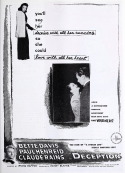
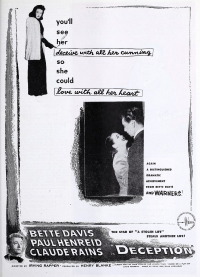
A few years after their success with "Now, Voyager," director Irving Rapper and actors Bette Davis, Paul Henreid, and Claude Rains teamed back up to make another picture: "Deception." But this time they had less success. "Deception" isn't a terrible film. There is much that is wonderful about it, but there is a lot wrong with it. It could have been and should have been much better.
Davis, Henreid, and Rains play classical musicians caught in a torrid love triangle that ends violently. Rains plays a world-famous, very wealthy composer. Davis is his paramour and a serious musician in her own right.
Henreid plays a masterful cellist with whom Davis was in love during the war in Europe. At the start of the film, Henreid resurfaces in New York, after having disappeared during the last phases of the war. Davis lunges at him, wanting to marry him immediately. She ends her affair with Rains and tries to pretend it never happened. But she's living in a palatial apartment that clearly was given to her by Rains. Somehow Henreid accepts that she paid for this apartment with a music teacher's salary. This is just one example of the many preposterous elements in the story.
Another weak aspect is the editing. Many scenes are 30% longer than they had to be. If this film had gotten a better editing job, I might have given it an 8. It's got all the makings of a good melodrama. If it had been filmed in the taut way that "Sudden Fear" was in 1952 (a melodrama that starred Joan Crawford and garnered her her third and final Oscar nomination), "Deception" would have turned out a lot better.
"Deception" tried to be more than it was. It was a fairly ordinary melodrama. Melodramas always come out better when the creative team accepts that they're making a genre picture (as was the case with "Sudden Fear"). The team behind "Deception" couldn't accept that. They wanted to pretend they were making an A picture. Instead of developing the story from B to A, they tarted up the script with words like "effrontery," "abject," and "virago." They inserted serious classical music here and there. And they made every scene longer than it had to be. Bloating a film does not turn it from B to A.
"Deception" is a melodrama with A-movie window-dressing. A melodrama with delusions of grandeur. Every step of the way, its own delusions get in the way of its effectiveness.
This review of Deception (1946) was written by William D on 01 Sep 2012.
Deception has generally received positive reviews.
Was this review helpful?