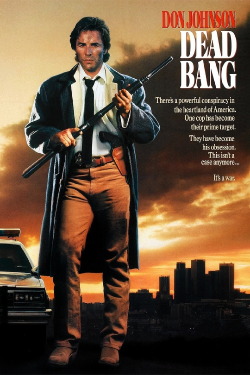
Review of Dead Bang (1989) by Paul Z — 12 Jul 2011
Thereâ(TM)s a specific brand of cop in film and on TV that apparently appeals to audiences. Typically, heâ(TM)s alienated from his family because heâ(TM)s too dedicated to his job and consumes too much of his time doing it and not enough with them. Or debasing brutality has taken too big a chunk out of his consciousness for him to frequent the society of women and children. Generally, he eats three meals of pizza or Chinese and drinks like a fish. The company he keeps does nothing for his lexicon. And the first thing everybody tells him is that he looks terrible. In Dead Bang, Don Johnson plays this classic brand of cop, to a tee.
Has anyone ever made a movie about a good cop who is neurotically orderly? The one perhaps determining stroke contributed by Dead Bang is a scene in which the inebriated investigator heaves onto a suspect. His name is Beck and on Christmas Eve heâ(TM)s designated to probe the murder of another LA cop. He produces the name of a freshly paroled offender apparently affiliated with a disheveled band of white supremacists.
There are a few rows and gunfights, and a Fed overplayed by William Forsythe imposes himself. Also, due to his wreckless ways, which appear somewhat restrained relative to that of most movie cops, Beck is ordered by the chief to obtain permission from a police shrink or be removed from the case. However since Michael Jeterâ(TM)s counselor resembles Woody Allen, Beck breaks up and the doctor grows annoyed and the opportunity of remaining on the case seems remote, that is till Beck has a very unclinical, clear-cut and inhospitable talk with the slightly built fellow.
Near the beginning, thereâ(TM)s an unwanted detour in which Beck beds Penelope Ann Miller who, unbeknownst to him, was the wife of the murdered cop. But when he faces her with the information, thatâ(TM)s all and she never appears again. From then on out itâ(TM)s all boys, and there is some inexplicably evocative dialogue in which Beck and his contemporaries talk about âgoing through doorsâ? together. Beck says thereâ(TM)s only one thing that counts: Is there anyone whoâ(TM)d be afraid to go through a door with him? And later, his police chief replies, âI want you to know that Iâ(TM)d go through a door with you anytime.â?
Johnsonâ(TM)s eyes look aloof, but heâ(TM)s got some presence here, doing the work and really deriving something appealing out of the formula. As the burdensome G-man, Forsythe is the essence of trivial-mindedness. At one point, he looks at a shivering Beck with gravitas and says, âYou didnâ(TM)t bring a cold-weather coat? Whatâ(TM)s wrong with you?â? Also, Bob Balaban, as a whipped parole officer, and Tim Reid, as a local police chief, give their roles some punch.
However, what the audience sees, actually, are a couple of white-supremacist psychopaths with a fixation on racial purity and homemade apple tarts. Their main advocates are a handful of dim-witted Hellâ(TM)s Angels sorts who, when they need funds, raid the Mexican bar right next door, kill everyone in it and then are astonished when the authorities appear. John Frankenheimerâ(TM)s control is tight enough but quite mechanical: He sustains the action but doesnâ(TM)t furnish much character. Then again, Robert Fosterâ(TM)s script is speckled with crumbs of peculiarity, practically all of them minor. Frankenheimer, the director of three of the most sharply honed and deeply affecting conspiracy movies ever made, is also responsible for some of the more negligible.
This review of Dead Bang (1989) was written by Paul Z on 12 Jul 2011.
Dead Bang has generally received positive reviews.
Was this review helpful?