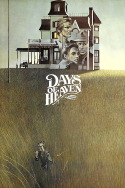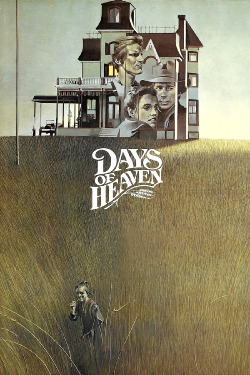
Review of Days of Heaven (1978) by Cameron J — 07 Apr 2012
Just when you thought Terrence Malick's religious overtones couldn't get any more unsubtle, he just went ahead a tacked on "Heaven" in the title. Man, it is pretty much his life goal to be the religious nut version of Stanley Kubrick, who was most certainly no religious nut. I can't think of too many overly christian people who would make movies like "2001" - a film about evolution and human-minded machines -, "A Clockwork Orange" - a film about a teenaged rapist and murderer - or "Eyes Wide Shut", which isn't so much anti-theist because it was about a cult that engaged in pagan rituals of a certain dirty nature, but because that film was some kind of abomination. Still, Malick's stylish, narrated, meditative films are close enough to Kubrick's that I think the reason why Kubrick died a year after "The Thin Red Line" came out was because upon realizing that Malick was still interested in film after a 20 year absence, he felt that it was time to pass the torch and leave this world. Well, either that's the reason he died, or because he actually watched "The Thin Red Line", and after the year it took him to watch it, he died of boredom. You can compare Malick and Kubrick from a lot of angles, but the fact of the matter is that, With the exception of "2001" and - woah boy - "Eyes Wide Shut", Kubrick's films were never dull on a Terrence Malick level, and ladies and gentlemen, this was the film that started it all, as well as ended it all for about 20 years, because after watching his own film, Malick had to take that long to sleep. I love how I keep hammering down on all of his films for being numbingly boring, and yet I still kind of like them, or at least the ones after this, because this film is just too much of what's wrong with him, which isn't to say that there's not still plenty of what's genuinely good about him that's here to keep this project from completely falling apart.
Terrence Malick knows how to summon powerful work from great score composers, and Ennio Morricone is no exception here, composing a score that's unique and soberingly tender. Sure, maybe the score is a little too sobering, to where it exacerbates the overly meditative atmosphere, but it is still so very beautiful and atmospheric, something that can also be said about, well, the sound design, and I know that sounds weird, but even back then, Malick had such an excellent taste in manipulating sound to gather pure atmosphere; again, maybe to a fault, yet it's still an immersive experience, listening to the awe of nature. Audibly, the film is engaging enough, but this film accels the most visually, boasting cinematography that may have date over the years, but was, for its time, truly incredible, and remains fairly impressive today. The colors bounce and the scope is with some degree of sweep, yet still plenty of intimacy with the environment, and when the environment hits its magic hours of sunsets, sunrises and overall awe, it's hard not to be captivated. Stylistically, I would consider Malick a genius, even if he is such a poor storyteller, because as messy as his films get, the artistry that his projects are built around is typically so very stunning that you almost disregard the missteps in storytelling and see the final product as, more often than not, genuinely good somehow. However, as excellent as the film is visually and audibly, it doesn't quite deliver as thoroughly as Malick's other efforts, and style is typically all he's got going for him, next to worthy stories, excellent performances and even some pretty sharp emotional resonance. Here, all of that diluted, if not completely gone, and while that's not enough to make the film ultimately dismissable, there really is nothing left to fully redeem the glaring flaws in Malick's style, especially when most of those flaws are at their most intense here.
There's always something to say about a Terrence Malick film, and that something is typically nothing, in that there are a good couple of periods in, well, pretty much all Malick films where absolutely nothing is going on, and that's especially the case here. When I think of a film doing nothing, I usually think of a story that's just bloated with excess material, but most of the padding here has absolutely nothing to do with anything, and I know that sounds like some kind of exaggeration, but I assure you that it is most certainly not. Even the meditative nothingness of some of your newer Malick films have some moderate degree of relevance to the story - such as it is -, but with this film, most every bit of padding - of which, there is plenty - is so startlingly superfluous and irrelevant to the plot, and I can't help but feel as though a big reason why is because there's hardly a plot to begin with, and what plot there is finds itself plagued by Malick's typical lack of care, at its most intense, to where the scarce amount of plot is rendered so lifeless that if you do manage to notice it, you'll find yourself confused as all get-out, because Malick treats story substance with such an afterthought sensibility that most every chunk of what plot there is just doesn't stick, plain and simple. This is another typical flaw in Malick's films, only it's much more intense here, whereas something like numbing slowness is just as bad as it always is, yet with most every other flaw being so highly worsened, it makes the dullness sting a little bit more. The film is so ridiculously atmospheric, plagued by quiet meditation on superfluous imagery and nothingness, and with little, if any of Malick's typical cover-up, you really see just how bad of a storyteller he truly is. He's proven himself to be a more than competent director, particularly in recent years, but the man is totally incapable of creating versatility in his stories - such as they are - or even telling his stories well in the first place. There's enough stylistic dazzle in this film to save it, but quite frankly, to be blunt, this is some boderline bull, and truly shows that if Malick does not deliver on style, then he has nothing, and until we see the day that may never come - though honestly could - where Malick's style falls so flat that his typically tedious product is rendered unpalatable, this is his true failure as a filmmaker.
Overall, the film goes saved by Terrence Malick's trademark fabulous taste in score, sound and, of course, cinematography, but with that artistry not quite being up to par with the style in other Malick films, and with plot, emotional resonance and acting material being all but completely wiped clean from Malick's vision, there is nothing to make the film genuinely impressive, let alone to cover up Malick's other trademark of poor taste in storytelling, comprised of unrelenting nothingness, montony and convolution, which is at its worst here, and made all the more intense by what might be Malick's biggest trademark of all: agonizingly overly atmospheric, overly quiet dullness, thus making "Days of Heaven" a mediocre bore of an overly meditative film that may never descend beneath mediocrity, but stands as more of a testament to what's wrong with Terrence Malick than a testament to what's respectable about him.
2/5 - Medicore.
This review of Days of Heaven (1978) was written by Cameron J on 07 Apr 2012.
Days of Heaven has generally received very positive reviews.
Was this review helpful?