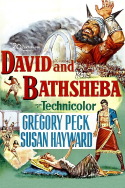
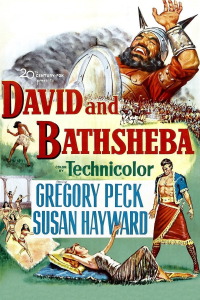
Review of David and Bathsheba (1951) by James H — 12 Aug 2009
Biblical adaptations always appeal to me as a kind of shortcut to actually reading the Bible. But after watching the film, I usually realise that (1) much of it is either inaccurate or the product of invention and (2) it would have taken me less time to read the relevant bible chapters instead.
This is exactly what I discovered after enjoying this biblical romance: the whole story takes about two pages in my RSV Ignatius Holy Bible, which would have taken me about a quarter of an hour to read carefully; and the whole ending is completely made up.
At the risk of spoiling the film, the main divergences with the biblical account are a major inversion in the narrative (in 2 Samuel, Nathan tells the story of the lamb before David's son falls ill and dies; here, we jump directly to the end of David's seven-day penance, the son dies, and Nathan tells his story); and the invention of a whole subplot in which the people rise against David, demanding that Bathsheba be lapidated, and David goes to the Tabernacle, does additional penance, and is vindicated by God. In 2 Samuel, David's son dies, and then it is written: "Then David comforted his wife, Bathsheba, and went in to her, and lay with her; and she bore a son, and he called his name Solomon. And the Lord loved him, and sent a message by Nathan the prophet; so he called his name Jedidiah, because of the Lord" (24-25.).
This said, the added bits, if purely invented, did not seem to me to betray the Old Testament theology, contrary to many modern films which not only reinvent the facts, but make up completely bogus theologies, either as strawmen, or for shock value, or because the screenwriters want to show how clever and original they can be. So the truth of the story is preserved, if not the facts. What the screenwriter probably tried to do was to reconstruct the psychology of David from the Psalms that are attributed to him (a perilous exercise.).
What seemed wrong, however, was David deliberately touching the Ark of the Covenant as a way of testing God. This was an act of desecration, which showed more defiance of God's commandments than trust in his mercy.
The Tabernacle itself probably does not conform to the biblical descriptions, which are rather detailed. In particular, I seem to have spotted that the altar to burn incense had four rings, rather than two as described in Exodus 30, 4. But that's nitpicking.
The flashback in the last sequence I also found to be a mistake from a dramatic point of view. It might be interesting to edit it out and see whether the film does not work better that way.
For a comparison, I suggest the TV movie "David" starring Nathaniel Parker and Sheryl Lee. It covers the whole story of David (with Jonathan Pryce as Saul and Leonard Nimoy as Samuel), and is therefore longer (190') but I seem to remember that it was more faithful to the original. (The Old Testament titles in this series are rather good, while the New Testament ones are generally mediocre, quite unexplainably.).
This review of David and Bathsheba (1951) was written by James H on 12 Aug 2009.
David and Bathsheba has generally received mixed reviews.
Was this review helpful?