Review of Dark Passage (1947) by Edith N — 16 Mar 2009
In my opinion, San Francisco is the best city going for noir. There's all that fog, for one thing, which has the added benefit of making the streets wet and reflective. It's large enough to hide in, but not so large that you can hide forever. It's a beautiful city, but the downtown is newer--post-earthquake, most of it. On the other hand, there are enough old buildings to give the place a sense of history. It is a cosmopolitan place, in its way, a port city full of exotic people shipped in from exotic places, and it still holds the remnants of its Gold Rush days. And, of course, its nights are always cool enough for men to wander its winding streets and steep hills in trenchcoats. The very look and feel of noir has its heart in San Francisco.
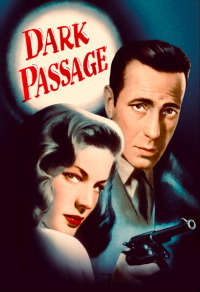
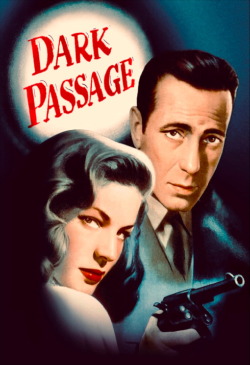
Vincent Parry (Humphrey Bogart) has been tried and sent to San Quentin for the murder of his wife. However, he knows he is innocent, and he escapes to find the true murderer. The first ride he hitches is with a man named Baker (Clifton Young), who figures out who he is. Parry knocks him out and escapes, ending up in the car of the lovely Irene Jansen (Lauren Bacall), who also knows who he is but hides him anyway. She turns out to be the daughter of another man executed, presumably for a crime he did not commit, and what's more, she knows at least one of Parry's own old associates. He goes off for plastic surgery and returns to Irene's for his two weeks' recuperation. When he is healed, he will search for the killer--who has also, now, killed his best friend, George Fellsinger (Rory Mallinson).
It is, of course, a little challenging to have an important clue to the solution of the crime be a colour, given that this is, per noir, a B&W film. I've not read the book, but I somehow suspect less emphasis is placed in its dialogue about what colour the important things are. Oh, I've no doubt the description is there, but people don't have to harp on it so. After all, a novel is adept at creating a picture in the mind's eye. The movie provides the picture for you. Oh, it's not a bad picture, of course; no picture with Lauren Bacall in it is ever a bad picture to have before you. However, it's one of the important places where book and movie differ as media.
Irene is an awfully trusting soul. Oh, she's quite sure that Parry is innocent. However, the evidence she's presented with when first she sees him again does not exactly strengthen that belief. He is, after all, pulled to the side of the road with the car's door open, beating a man lying on the ground in front of him. In fact, the minor detail of his having escaped from prison in the first place might give one pause. To be fair, I have no clear notion of how he might otherwise have solved the crime, given that he probably does not have the resources to hire detectives even could he find detectives who would be hired by him. However, regardless of how suspicious the situation is, Irene not only gets him into San Francisco but takes him into her home. Trusting.
Bogie and Bacall are one of the all-time great screen love stories. For one, they acted together well, their chemistry onscreen so sizzling that it raised suspicions of their offscreen lives. When she looks at him as he is walking out her door, the look of passion she gives him is not feigned. For another, it was only his death that separated them. Yes, she announced an engagement to Frank Sinatra, and yes, she remarried some time later, but for all of that, I cannot picture her without him. When I see her in my mind, I see her with him, and I know I am not alone in that.
This review of Dark Passage (1947) was written by Edith N on 16 Mar 2009.
Dark Passage has generally received positive reviews.
Was this review helpful?