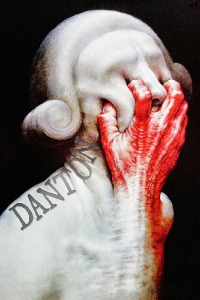
Review of Danton (1983) by Robben M — 22 Oct 2009
Andrzej Wajda's recreated period piece about the last months of Georges Danton is chilling, epic, surreal, and intensely searing in its piercing of political intrigue and corruption.
In this world, no one is spared, not even Danton, who's own idealism in the end gets him killed. But his fate is not just a footnote in history.
Wajda's film sets out to paint a society that has both endured a horrific struggle for...what?
And that is the question. Gerard Depardieu plays Danton in a towering performance that simply overwhelms everyone else, except for Wojciech Psoniak, who plays seemingly complex Robespierre, but in the end, turns out to be a cold and clinical bureaucrat who seems to have been deadened by his own lack of ambitions. Danton is full of life; Robespierre is not.
Wajda's movie traces Danton's return to Paris and his eventual downfall at the hands of the Committee for Public Safety. We witness Robespierre cold rationale for his reign of terror and his initial reasons for NOT simply executing Danton right there and then.
The film is less concerned with the overall political history of France, and instead treats it with a general flavor, using this particular moment in history as a microcosm for all governments and political ideologies. The film's opening images of a covered guillotine and then a boy who is being bathed naked, trying to recite the amendments but getting his hands slapped at every missed line, is both chilling and highly symbolic of all agencies that seek to control out of fear.
That is Robespierre's flaw in this film. His own efficiency ruins everyone as he systematically finds a way to remove his opponents despite his frequent statements that he is really just trying to help the people.
Wajda's Danton, by contrast, is vulgar, improper, loud, and full of life. Initially, he is shown to be a prime leader, delegating his followers to find ways of gaining favor with the people and thus dismantling the committee through non-violent means.
By the end, the tables have turned. Danton becomes a mess of dirty hair and sweat, trying to rally the people to his pleas of stopping despotism and tyranny. Alas, the rest is history.
But Wajda is both critical of Danton and the people themselves. Society is fickle. When Danton returns to Paris, we see it in the rain, from a distance, and with little fan-fare. We do not even know it is Danton until later. A footsoldier, from the people mind you, looks into the coach, and doesn't even recognize him. The guard simply instructs the others to make sure he doesn't tir up trouble.
Society ultimately forgets about Danton and his ideals. He is, as he always assumed he would be, destroyed by his devices which have come to haunt him. Wajda shows that this is the detritus of all governments, and no one will be spared.
Images of prisoners, smoke, and stale rooms abound. The film's color scheme and look is one of chill and cold. While watching, you feel as if you are physically losing warmth. This is visualized in several figures, namely Robespierre and his allies, most of who have clean, almost white faces.
Danton and his allies, by contrast, are often grizzled, unkempt and generally loud, except of course, for his traitors, but that's a different story.
The art direction is both minimal and austere. Scenes in the political prisons are impressionistic, with surreal images of prostitutes and beggars sitting in shafts of light and lying in bales of hay. Light pours through the cages.
In the hall, Robespierre stands alone, a covered grandfather clock the only object at the end of the barren hall, echoing the image of the covered guillotine seen at the beginning. Robespierre is death, as well as the walking undead in a rotten government.
There are other magnificent, symbolic images that never feel heavy-handed. Sometimes Wajda shocks you with his sheer skill of handling such amazing sequences. A scene in the hotel is mind-blowing: As Danton awaits Robespierre's arrival, he instructs his followers to remove all the guests. So they enter each room, each one filled with a different microcosm of upper middle class living. One is filled with exotic dancers. Another full of card players and gamblers. The final one is comically filled with a group commencing a seance, leaving still in a trance, the film's only moment of relief.
The music underscores the period look by being completely discordant and scary sounding, seemingly more appropriate for a horror movie, but that is Wajda's intent. This is a horrific event, not because of Danton's death, but because of the death of moral's and ideals for which people can live a noble life. There is no such thing, and that is cause for horror in of itself.
Perhaps it's most telling in the finale, where a sickly and pale Robespierre sees the small boy at the beginning reciting to him all the honorable words, not knowing what they mean at all, reciting out of fear and obedience. How ironic that it would all come tumbling down...
A masterpiece, to be sure.
This review of Danton (1983) was written by Robben M on 22 Oct 2009.
Danton has generally received very positive reviews.
Was this review helpful?