Review of Cutie and the Boxer (2013) by Shiira — 17 Oct 2013
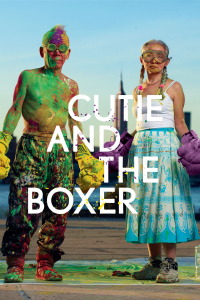
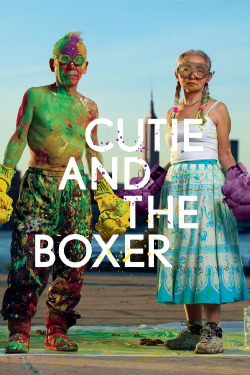
Over the end credits, the Shinoharas, Ushio and Noriko, minor figures of New York's modern art scene, spar together with paint and gloves in a faux boxing match. While both are old, Noriko is a relatively spry chicken compared to her husband, twenty years his junior, and takes it easy on the octogenarian, in a fight that is more about abstract body painting than pugilism.
Deceptively playful, the intended metaphor(that for a woman, marriage can be 15 rounds of emotion, and perhaps, physical violence) doesn't quite connect, because Ushio, best known for landing punches laced with acrylics on wall-sized canvases(think: Jake LaMotta as an action painter), fails to provide a catharsis that is satisfying for Noriko, because her husband(the inspiration behind Bullie in her comic book-inspired art) owes it to his wife to hit another sort of canvas, the kind that real boxers meet following a TKO.
Cutie, Noriko's alter-ego, is ofter portrayed in the nude, mostly to convey her constant state of poverty, but such hyper-vulnerability hints at the possibility of spousal abuse and infidelities. Was Noriko a living canvas, a punching bag like LaMotta's wife, Vicky, from Martin Scorsese's Raging Bull? In Cutie and the Boxer, not only is the crowd-pleasing fisticuffs coded in black eyes and bloody noses, but also the name of the Shinohara's joint exhibit, Love is a Roar, a title suggested by Noriko that makes Ushio look visibly agitated, no doubt, due to the potential of a nebulous undercurrent that runs beneath the seemingly affectionate appellation.
After all, bulls roar. Like the former middleweight champion, Ushio was an alcoholic, who would follow the same predictable downward trajectory of all celebrated men, finding themselves at a loss, after they see their brush with fame finally runs its course.
In his halcyon days, Shinohara was a Factory regular, where in one clip, we see him palling around with the pop art impresario himself, Andy Warhol. But for Ushio, it really was fifteen minutes. His art never sold.
Despite all the years living abroad in the US, the Shinoharas, longtime Brooklyn residents, are still expatriates at heart; their Japanese mindset never quite fully subsumed by the cultural norms of the west, perhaps, best exemplified by the woman's adaptation of red snapper into sushi.
Red snapper, the antithesis of bluefin tuna, is hardly the sort of fish that would make a cameo in the Jiro Dreams of Sushi. It's ghetto sushi; it functions as the chief metaphor for their destitute state.
But out of compassion, Noriko allows the pitiful old man to "save face"(a Japanese tradition that allows the man to maintain his dignity), and lets "Bullie" remain fully-clothed. After all, their rundown apartment, by itself, is a damning testament to Ushio's flaccid shortcomings as a man and artist, without Noriko having to delve, on the record, into the old man's hidden transgressions during their decades-old coupling.
She can afford to be generous. Once a shadow, a wisp of a thing, Noriko, whose comic book panels, now expanded into a narrative-driven mural, in A Star is Born-style, attracts more fanfare than her former mentor's retrograde offerings at the exhibition, correcting Ushio's assertion that "the average one has to support the genius.
" In Scorsese's Life Lessons, we can see how Noriko, 19, newly arrived from Japan, could end up being impregnated by the much older Ushio, through the prism of the teacher/student dynamic in which Lionel Dobie, a famed modern abstract painter, uses Pauline, his muse, for sex.
The short film buys into "the cult of the great artist", most chauvinistically in the scene where the unformed female underling, still hot after a fight, melts, eyes softening at the sight of her grizzled and wizened mentor, like a titan at his medium with brush in-tow, attacking the canvas with sweeping strokes.
This sort of unconditional adoration and belief in a man's artistic prowess, one postulates, is how Noriko ended up in such an ugly man's bed. At her advanced age, however, some of this worship still survives, as when Alexandra Munroe, a Guggenheim curator, comes knocking on their tenement door in search of a particular "boxing painting", transforming Noriko, the artist, back into a sycophant.
In Ha Jin's novel The Crazed, Weiya, a student painter, once attached to her older professor, says, "I'll sell my paintings to support myself. Why should I continue to live under others' thumbs?" Likewise, Noriko doesn't need Ushio anymore.
And arguably, Lee Krasner's career was derailed somewhat by her husband Jackson Pollock. And yet a human being, even a strong woman, needs love for survival. Never mind if that love is flawed. Consider Virginia Woolf, Noriko's hero, who once said, "Women need a room with a key and some money.
" Sure, Woolf had a locked door and the means to support herself, but she ended up at the bottom of a lake.
This review of Cutie and the Boxer (2013) was written by Shiira on 17 Oct 2013.
Cutie and the Boxer has generally received positive reviews.
Was this review helpful?