Review of Crossfire (1947) by Blake P — 03 Aug 2016
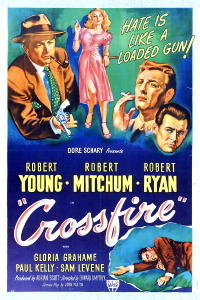
Message pictures have never much been my forte - preachiness sometimes overcomes cinematic riskiness - but there's no denying the power of Edward Dmytryk's "Crossfire," a low-budgeter so socially stirring in 1947 that its shoe string origins hardly mattered to audiences upon release. It amassed a huge sum of money at the American box office and was nominated for five Academy Awards, one being for Best Picture, which had not yet accomplished by a B-movie up until that point.
Considering its fearless backhanding of racial prejudice in modern society at the time, its cultural wave-making is no surprise. Prominently putting a spotlight on anti-Semitism and overtly expressing the needlessness, the ugliness, of hatred, it grabs ahold of us both intellectually and emotionally, a rarity for a 1940s that preferred movies without much on the mind (and without much by way of dealing with racism on a silver screen scale).
It was one of two anti anti-Semitism centered movies released that year, the other being Elia Kazan's "Gentlemen's Agreement," which garnered more critical and commercial attention and is widely said to be the superior. But "Crossfire," visually claustrophobic and temperamental, is stimulating nonetheless, even if its dialogue sometimes tends to mimic soapbox heat and even if some of the characters are more mouthpieces for screenwriter John Paxton than they are multifaceted creations.
The film concerns itself with the brutal murder of Joseph Samuels (Sam Levene), a Jewish man last seen hanging around a group of discharged soldiers. Suspicious of the circumstances regarding his demise - he's certain that turned heads and white lies are coating the actual truth - police investigator Finlay (Robert Young) embarks on an intense search for the culprit. As does Sergeant Keeley (Robert Mitchum), the protective friend of a possible suspect (George Cooper). But while they differ in their investigative methods, Finlay and Keeley find themselves increasingly distrustful of Montgomery (a terrifying Robert Ryan), a tyrannical bigot that was with Samuels in the hours leading up to his death.
"Crossfire" mostly fills the mold of an archetypal whodunit, spending a plentiful amount of time staging flashbacks (as a way to three-dimensionalize the stories told in interrogations) and occupying the scenery with skeptical persons of interest (most memorably with potential witness Ginny, who's exceptionally portrayed by Gloria Grahame). It's analogous to the mystery novels of Agatha Christie, only the characters are less eloquent, the investigator isn't an eccentric cartoon, and the murderer is fairly obvious. (And it's more pivoted toward its moral lesson; its enigmas are generally unimportant.).
But I admire its determination to make a statement, which is, fortunately, constructed efficaciously. It's dated, mostly since the topic at hand is not as rampant as it was sixty years, but its anger holds up. And, most interestingly, we feel cohesively transported into 1947, where post-war cynicism, where intolerance, and where the hysterical - and ridiculous - Communist witch-hunt were widespread normalities of society. That sensation is perhaps more engaging than the film itself (which is still pretty damn good).
This review of Crossfire (1947) was written by Blake P on 03 Aug 2016.
Crossfire has generally received positive reviews.
Was this review helpful?