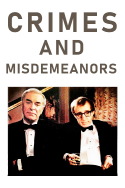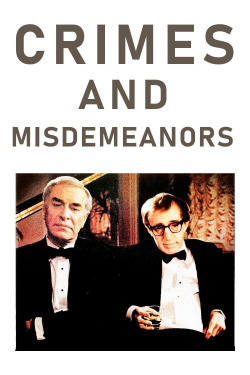
Review of Crimes and Misdemeanors (1989) by Carl S — 25 Sep 2007
There is no justice in this world. This is the theme that spoke the loudest volumes in Woody Allen's "Crimes and Misdemeanors".
Judah Rosenthal (Martin Landau) is the upper echelon of society, heck he's the upper echelon of "high" society. An optomolegist being honored at a banquet for his generous donations and accomplishments. But, just before we decide we like the man, we're introuduced to Dolores (Angelica Huston), through a letter she wrote to Judah's wife, confessing a love affair the two are engaged in. He promptly burns it, and from there, we can see this man has serious problems.
On the other side of the story we have Clifford "Cliff" Stern (Woody Allen), a typical Allen character, he's a hapless filmmaker in an unhappy relationship, doomed for failure. Cliff's problem is his sleezy brother-in-law, Lester (Alan Alda). A man Cliff loathes more then anything else in the world, yet, to keep from starving, is obligated to make a TV segment that will project his "genius".
Throughout the course of the film we switch back and forth between Judah and Cliff's lives. At first, these stories seem to be connected only by a mutual aquantance (Judah's patient and Cliff's brother-in-law) that we see in both of our main charcter's circles, Rabbi Ben (Sam Waterston).
Rabbi Ben is an optomististic charcter with failing eyesight and, as his profession would suggest, a strong faith in God. Judah has a strong dilemma, he can't destroy his wife emotionally, and tarnish is reputation within his community.
During an optomolegy appointment with Rabbi Ben, he confides in him. After he tells him his entire situation, the Rabbi optomistically remarks, "Sometimes when there's real love, and true acknowledgment of a mistake, there could be forgiveness." If only it were that easy.
To Judah, his life is not his wife, it's the shell he's protected in with his wife. The formiliarity of it all. It's his community, his reputation. And he will do anything to protect that...anything. This includes going to his mob-tied brother Jack (Jerry Orbach, who really looks like Landau's brother), for advice. Jack's suggestion is somewhat different from Rabbi Ben's, but it seems more up Judah's alley. Taking no chances, Judah ultimatley decides to take Jack's advice and have her perminatley 'removed'.
Meanwhile, Cliff is shooting his egotistical brother-in-law's special and hating it. But while on set, he meets the show's producer, Hally Reed (Mia Farrow), and instantly falls for her.
Cliff is married to a woman who obviously dislikes him (Joanna Gleason), and because of this he has no overwhelming guilt about his feelings for Hally. But Hally, because of his marital status, is in no rush to start a relationship with him. Despite this, there's a definite connection between the two of them. When Cliff askes her for champagne she answers, "I never say no to champagne, or caviar", to which Cliff replies, "Great, but I have no caviar, I have oat brand.".
Across town, Judah is overcome with guilt. He knows what he has done is going to spell fate some how, some way.
There's a truly wonderful scene where he goes back to his old house and recalls an old debate from his family table, when he was just a kid. This scene shows where the moral dilemmas in his life could have stemmed from.
As his guilt mounts, a Detective makes an appointment to see him, though the appintment is just a few basic quetions about patient history, Judah's tortured conscience can take the guilt no longer.
Cliff's problems come to head as well, when he not very romantically proposes to Hally. But she can't, she's going away. She was offered a production job in London.
And just like that, four months goes by for our main characters.
We meet them all again at a now blind, Rabbi Ben's, daughter's wedding. Cliff's problems only intensify as he sees the girl of his dreams, back from London, engaged to his archrival. "I think it was caviar that did it." explains Lester.
Cliff and Judah find themselves away from the party, and joined together for their first scene together. A bizzare discussion about the "perfect muder" insues. A now guiltless Judah, describes the muder he has gotten away with. Judah has made his choice, and is proof that many times, human resiliance goes hand in hand with human selfishness.
It is not until the final moments of the film that I saw the message behind it all: there's no justice in this world.
This review of Crimes and Misdemeanors (1989) was written by Carl S on 25 Sep 2007.
Crimes and Misdemeanors has generally received very positive reviews.
Was this review helpful?