Review of Cries and Whispers (1972) by Emanuel D — 14 Sep 2007
I have found that I think more about God than people who say they believe there is one. I don?t believe in God, but I?m afraid of him. For there can be no God, but without one all this wrong will never be made right.
At the side of the deathbed a priest makes a moving prayer. The woman who has just died has suffered a long and painful illness. Of her family she seems to be the most loving, generous, kind woman, one whom the world should have enjoyed more and for longer. But in His infinite wisdom and unfathomable sense of timing God took her away.
The priest (Anders Ek) speaks at her corpse. He tells her to put at God?s feet her burden and her suffering and it is then that He should be most inclined to hear her prayers. She should plead on behalf of those she left behind in this valley of meaningless tears, in this sick world of cruel people.
There can be no God. But if there is one, may He hear the poor woman?s prayer because most of us carry too much shame and burden to dare to look upon God.
Agnes (Harriet Andersson) has lived in her family country home alone with her servant Anna (Kari Sylwan). They depend on each other. There is almost little doubt they are lovers. Agnes is dying. Her pain is unbearable to watch. Some cruel cancer is eating her from the inside.
Her sisters join her in her last days. Through their countenance, their dialogue or lack of it, their tensions and the penetrating glimpses into their memories we are exposed to the rot, guilt and evil that force the priest to pray.
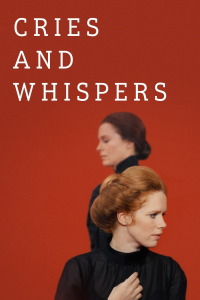
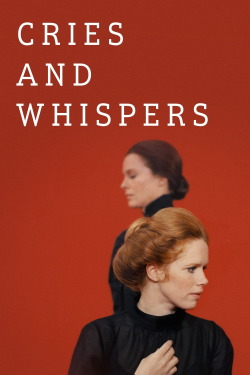
One sister, Maria (Liv Ullmann), is sensual and beautiful. She must have dominated every room she has been in all her life. One can imagine every uncle, every teacher, every visiting family friend showering her with attention and forgetting her plainer sisters. One can imagine her coquettishly drawing her sisters? admirers to her.
The film tells of her affair with the family doctor (Erland Josephson). We see her seduce him but in an unforgettable dialogue in front of a mirror, we hear him say how he sees through her. She does not blink. But Bergman?s camera is too close to her eyes to hide from us what she does not manage to hide from her lover but would try to hide from other people in a room.
She hates herself. She hates her life. She hates her husband. She hates her marriage. Beneath her red hair, her full breasts, her cold eyes, the maturity of her middle aged beauty, is an unquenchable self-loathing.
The other sister, Karin (Ingrid Thulin), is in even more obvious agony. Her shell is thinner than her sister?s. There is a harrowing desolation, an unbearable loneliness about her. In the flashback we are offered of her memories, to get a glimpse of the blackness she carries in her heart, we also see the barrenness of her marriage and the meaninglessness of her formal, rigid existence. Slowly, ritually, we see her helped out of her infinite layers of stifling, suffocating clothing. We see her stripped down to her cold, unfeeling nakedness. And then, in a primordial, disconcerting scene we see a cruel form of masturbation that has a harshness proportionate to the extremity of her death wish.
Though this is not a political treatise, we see in their proto-Victorian bourgeois rituals, ethics and etiquette, the blanket under which the vilest horror is tucked away. Life, marriage and rites of passage such as pretend family solidarity, funerals, religious rituals and mourning carry on regardless of the guilt, the hypocrisy and the moral illness inside.
The savagely painful cancer that kills Agnes is not something anyone would wish. But the cancer that eats the souls of Maria and Karin is worse. This is a cancer that does not kill and for that it is worse: there is no reprieve from the pain and the hurt caused to others; no relief at a peaceful end.
As a counter-point to Maria and Karin, there are Agnes and Anna, particularly Anna. This is not a political treatise which means that Anna does not earn our admiration because of some working class hero crap. Unlike the cold indifference of Maria and the bloody death wish of Karin, Anna has a simple unshakeable faith in God. She too does not fathom God?s will. God takes from her Agnes whom she loves as a loyal servant, as a doting mother, as a caring nurse, as a generous sister and as a tender lover. He had taken from her a baby daughter sometime in the back story of her life and she seems to have no anger, no regret, and a sweet pain of a pure martyr about her.
Twice we see her full breast and naked shoulder comforting Agnes. The picture of her body made me think of the paintings of nubile virgin martyrs executed in Christian legend by heathens who had given them the choice between death or giving up their virginity to them. Their luscious bodies are sacrifices to Christ and there is a pleased stoicism in their ambiguous smile, a peaceful glory at the moment of their death.
Maria and Karin envy her but it?s not appropriately bourgeois to sufficiently recognise the importance of a servant to express their resentment aloud. Instead they try to ignore her and then they go out of their way to degrade her when it?s time to let her go.
She does not seem to react with anger. She does not seem to have the capacity to be angry. But a dream sequence which we see is our look into her complex psychology which is more complex than merely common place fear of God.
Like with preceding interruptions to the temporal storyline, we now look into Anna?s eyes and the red that dominates the set of the film bleeds and floods our vision. In the blood we see the past like witches who would read someone?s thoughts and desires in a pool of their bood.
Anna?s dream is chilling in its morbidity and expressiveness. It is a scene that punishes the viewer but it seems to be about a auteur who has enough guilt to want to punish himself and let us watch him scream out his animal agony.
When the two sisters run away in disgust from their sister?s corpse, they scream and cry and wail and shed for a while their formality and dignity. But they don?t shed enough of it to seriously confront the hideousness of their lives and their existences.
They seem to try for a while. We don?t hear them but it seems that one evening they come close to each other and tell each other stories of their lonely lives apart from each other and apart from the world. But soon they put their masks on again to continue to live with the disease that is our life here on earth.
There is no God. And there is no better life after where we can shed at God?s feet the burden of the suffering, whether of innocent physical pain or the agony of guilt and moral torment. But no one who says that with conviction can be happy about it. For me, Bergman cries because he has fathomed there is no God whose unfathomable wisdom might one day after eternty have explained the slimy rot in which we must wade to go nowhere, it would seem, but to die beneath it.
This review of Cries and Whispers (1972) was written by Emanuel D on 14 Sep 2007.
Cries and Whispers has generally received very positive reviews.
Was this review helpful?