Review of Crash (1996) by Filmbuff94 — 30 Mar 2016
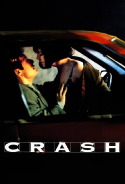
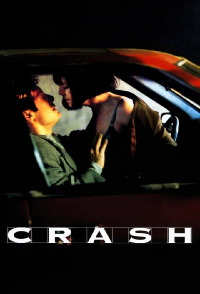
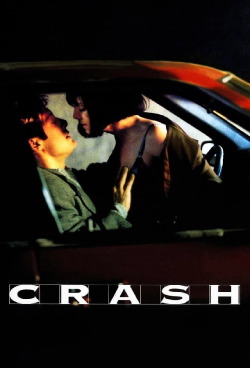
Strip way the abstract concept of love and what's left is primal desire fueled by need. But human beings don't like being told they're animals, so they allow their imaginations to construct fantasies to help them justify those needs. J.G. Ballard's novel Crash was pornography for philosophs, with technology as the illusion of choice. A secret society indulges in car sex, leading to accidents as erotic set pieces. The novel and David Cronenberg's film adaptation implicitly state that crashing cars during intercourse allows us to feel genuine sensations as opposed to the numbness of society, jobs, and conversation. It's a far out, all or nothing premise. What's disturbing to audiences isn't that Crash condemns such amorality, but that its characters are stretching their battered and scarred bodies into something new. Very little is discovered about these people besides their extreme proclivities. To give you an idea: the character named Ballard (James Spader) winds up sticking his dick into the serrated leg wound of a crash survivor (Rosanna Arquette) and walks away happier for it.
Anyone willing to go along for the ride may feel repulsed, but Cronenberg has used grotesque images in his work to show mankind's ability to transform itself. If it weren't automobiles, which summon up the right metaphor for full throttle sex, it would be computers (eXistenZ) or television (Videodrome). Cronenberg has made frequent claims that his work has little to do with technology, but he continually returns to the concept of a “new flesh” forged from manmade industry. Whether you see the fusion of Flesh and Other in his movies as a blessing or a curse pretty much sums up your definition of 20th Century Disease: Are we so bored with life that we resort to self-mutilation to define ourselves, and is that really any better?
Cronenberg seems to think so. His final image of two crash survivors groping each other and whispering, “Maybe next time, darling,” while an overturned automobile rests beside them is an optimistic one—a happy ending for a married couple that's communicating better now than they ever have before. The three sex scenes that open Crash show how desperate this modern husband and wife are at the start, having extramarital sex in public places, then coming home to sadly **** each other and describe their increasingly banal affairs. Since we're given almost zero insight into Ballard or his wife Catherine (Deborah Kara Unger), with no hobbies or defining characteristics, we're left with blank slates. That's 20th Century Disease for you: marriage, perfect clothes, a lovely house, affluent but non-distinctive jobs (he's a commercial filmmaker), and sex devoid of mystery.
The characters are treated with all the sympathy of amoebas seen through a microscope, and are less important than the sensations they pursue. Vaughan and Catherine fondling each other in the back seat while Ballard drives through a car wash, gazing at them in the rearview mirror, feels like a head trip back to the womb. When they stop, minutes later, to visit a car accident that's all hunks of smoking metal and busted-up, non-communicative survivors, Vaughan rages through taking photographs—and somehow his gum chewing seems the sleaziest thing here. It'd be grotesque if Cronenberg weren't viewing it all dispassionately, with that passive, obsessive, strangely Canadian voyeurism. It doesn't feel icky because it asks the question, “Let's see how it all works,” and that these weird beings are forging some sort of new community out of their collective desires.
The minimalist storytelling feels hermetically sealed, somehow. As if giving the characters any passion outside of what Cronenberg is interested in would humanize them and make them vulnerable to our judgment as audience members. Instead, we're told that this is the world they're in, without excuses or pity. The cinematography and score, by longtime Cronenberg partners Peter Suschitzky and Howard Shore, respectively, feel distant and tinged with an unusual combination of grayish metal and sensual longing. This provides the essential soulful quality of Crash, and elevates it above a story of sick individuals resorting to the most primitive mating rituals as fantasy or escapism. Cronenberg takes them seriously, and if he takes himself and his thesis a little seriously too, at least he parcels out a certain kind of egghead intellectual humor. When Ballard questions Vaughan about “the reshaping of the human body by modern technology,” Vaughan snickers that his B.S. theory was a clever ruse to get curiosity seekers through the door. In other words, psychobabble is cheap. Just shut up and **** me.
This review of Crash (1996) was written by Filmbuff94 on 30 Mar 2016.
Crash has generally received mixed reviews.
Was this review helpful?