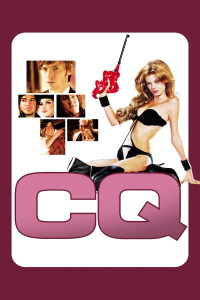
Review of CQ (2001) by Ken S — 05 Dec 2012
"CQ" Reviewed by Paul K. Bisson.
One of the taglines from Roman Coppola's "CQ" is "every picture tells a story." Indeed. Unfortunately, the writer/director (son of Francis) also believes that every story is worth telling. This is where "CQ" falls short. It's three movies all rolled into one. Well, sort of. Actually, it's really only one movie--about the making of two movies. Still with me?
Its 1969 and the revolution that swept through French cinema is all but at an end in Paris. Most of the visionary and radical techniques developed during La Nouvelle Vague have been absorbed into mainstream movie-making. So much the better. Those who once critiqued film, invaded the movie-making process. Renouncing the steady gloss and glow of Hollywood counterparts, their trademarks included dominant hand-held camera motion, natural light instead of manufactured, follow-spot tracking and convention-breaking editing styles that presented stories which favored the inner human struggle over exterior conflicts. Long, uncut takes, open-ended endings and improvised dialogue from mostly unknown actors were not uncommon elements for these directors who sought out the appeal of a younger, more influencing audience.
We meet filmmaker Andrzej (Gérard Depardieu), a veteran of this revolution hired by a main-stream producer to direct a main-stream "sci-spy" sexploitation film, "Dragonfly" (think "Barbarella"). Only he's not delivering on the goods. The bombastic producer (played with relish by Giancarlo Giannini) wants gloss, glitter and an explosive ending to top all endings. Andrzej would rather punch a hole through a wall than compromise his art. In fact, he does.
Enter Paul, the young American film editor, a meek, bleak character that Jeremy Davies plays so well. Paul is lost. He's searching for personal truth. Truth in love, truth in art, truth in life. He edits "Dragonfly" by day but uses his free time to produce a personal documentary, filming himself, his girlfriend and his sourroundings--an exercise he hopes will reveal the truth in his life.
But what happens when Andrzej is fired from "Dragonfly" and Paul is promoted? That's the strength of "CQ." Truth in art is put to the test as Paul finds himself in the director's seat. Truth in love is challenged when he falls for Dragonfly herself. Will he find his personal truth when all is said and done, or is personal truth something you make up as you go? What a wonderful theme to explore! Does Paul evolve from a boring, lifeless sap into a caring, feeling, hopeful individual? Here's a guy looking for the truth in his life yet he can't see the forest for the trees. Will he ever?
Coppola doesn't care to answer. Instead, the film trips over its own potential. It uses all three films ("Dragonfly," Paul's documentary, and itself) to tell the story. One moment we're watching Paul film "Dragonfly," and then we're actually watching "Dragonfly." This is a gimmick that has worked brilliantly in such films as "Living in Oblivion" and "The Big Picture." But it fails here. Why? Because it doesn't serve the movie. And why should it? It plays rather nicely on its own. Coppola knows his story and characters are barely above the line of interest and could never survive a straight telling of the tale. They need the gimmick. It's a diversion. It diverts.
What does that say about personal truth?
This review of CQ (2001) was written by Ken S on 05 Dec 2012.
CQ has generally received positive reviews.
Was this review helpful?