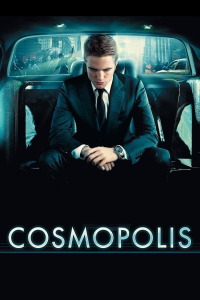
Review of Cosmopolis (2012) by Caroline L — 11 Oct 2012
This film is a deconstruction of reality, along a specific chain. If you saw it any other way, then you missed the main point of the film. It doesn't make someone stupid; this film is just not for most people. It's best seen by literary majors, IMO. Anyway, for how to make sense of the film, the chain: Deconstruct knowledge and information--these are only based on words and language in the end, so--deconstruct language itself--one can only understand reality because of language (as language is the basis of perception), so reality is subsequently deconstructed. I could write a thesis paper over the symbolism, dialogue, structure, nihilistic/absurdist comedia, and themes of this film/source book, and that's likely why so many people were put off by it--it's essentially the closest to a novel on celluloid that's been created (or, that I've seen), and how many mainstream viewers would answer yes if you asked them, "Wouldn't you love a film ultimately based on James Joyce's "Ulysses" and its stream-of-consciousness narrative mostly devoid of the public's definition of 'action'?" Yeah. And I know I sound really pretentious, but I'm not TRYING to be; I just love literature and everything its critical analysis encompasses, and believe pretension is subjective (I view it as presenting something as higher than it actually is, which I didn't feel Cronenberg to do, or like how I don't believe my review is the be-all explanation or more intelligent than other people, etc.) And combined with the overall theme of reality/nihilism/absurdism, the secondary current of the film is focused on Packer's lack of humanity due to his inexperience of pain. The entire film is a saga of him becoming slowly more human, in that sense, which excites him and propulses him--not because it makes him human, but because he does not KNOW what it is like (weren't you curious of just how many times or why they managed to slip that word into the film? Makes sense now, right?). And because knowledge and information are what drives him: each instance of violence or pain is a new piece of information he had yet to receive, and allows him another step closer to understanding (or, knowing) what it is to be human; the final frontier of information for him. Which is why, ultimately, he fulfills his knowledge of and conversion to humanity through death; though shown off screen, for THIS thematic aspect, the death occurred, and you could even argue that the point of death is the moment of purest happiness for Packer as he completes his knowledge, though ironically unable to feel it (or can he? ahhhhhh....up to the viewer). Of course, in the broad scheme, that is, within the context of reality as based on language and information--the ending is something immaterial materialized: a paradox. Because reality is based on knowledge, but knowledge (language/information) are also intrinsically based on reality's existence--EVERYTHING exists and does not exist simultaneously. You can't truly know anything, which is why Packer's quest was so futile. Because Packer wasn't shot on screen, does that mean he doesn't die? Does it mean he does, was it implied? You can't know--and that's the point, not whether he did or did not, but the fact that the knowledge is not provided, and a true reality cannot be conjectured, but what qualifies 'knowledge' in the first place? The film (and this increasingly long review) is a contradiction of itself, yet it still exists, and both levels of its existence can and can't BE. The argument made seems to state that physical experience (anything based in flesh and not conjecture or numbers, like Packer's entire life) is the only true form information can be taken from since it is the only thing an individual can unarguably know WITHOUT language; hence, also, the back-and-forth 'prose' of the film between all word and word-with-physical. Even though at the same time the film says it can't exist anyway, but it can, though it can't--et cetera. It's an endless loop because reality itself is unknowable to us, thus everything in the film comes with a contradiction and is ultimately unknowable. It's the intelligent (to me, genius) deconstruction of reality movies like 'Inception' only wished they could be (see that--that was pretension. Anti-Nolan viewer here, sorry). So of course a lot of people won't like it! If this is the shortest I can keep a review and still make sense of the film (impossible, technically!), then this is a TRUE thinking, brain-required experience, not one where things are still given to you but less so than in Transformers so it feels like it requires active cognition. So before I slip into pretension/derogatory mode like I'm starting to: I could be toooooootalllllyyyy wrong about everything; I'm just a 21 year-old kid with a lit. background, so what can I know? Which is kind of the point, in my opinion, but simply said, all this is just my interpretation, and the reasons I personally loved Cronenberg's Cosmopolis (even more than Videodrome, scarily). If you didn't like it, then, ok. Not film tastes or interpretations are something to deride someone by (...generally.....).
Acting, direction, screenplay, set and art design, cinematography, music--all fantastic. In my top five films of all time right next to Tree of Life on the list. Try 'em together; interesting antithesis/complements to the other.
This review of Cosmopolis (2012) was written by Caroline L on 11 Oct 2012.
Cosmopolis has generally received mixed reviews.
Was this review helpful?