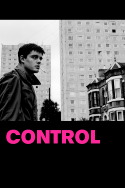
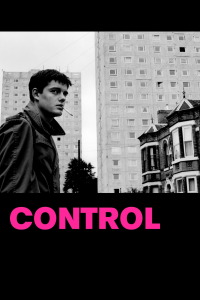
Review of Control (2007) by Todd V — 26 Feb 2010
Late on a summer night, last year. I lay on my bed, mind blown, having just listened to a recently acquired album-- Unknown Pleasures by Joy Division. After immediately becoming entranced by the band's name and album artwork, I had quickly resolved to check their music out. As "Disorder," track one, began to play, I fell in a singular kind of love.
And among the legions of people immediately wounded, made vulnerable, by Ian Curtis's sepulchral voice and the throbbing bass, the driving drums-- I became the newest member.
There is something about this Manchester band's sound that has a way of tearing down your defences and getting you in the gut. It is a one-of-a-kind experience, the kind that music fans crave for like junkies salivating for a hit. You feel part of something bigger than yourself.
With all that said, Anton Corbijn had a giant's task before him in creating a film about Ian Curtis, lead singer of Joy Division, that could satisfy the insatiable. In succeeding, he created a moving requiem for a troubled life-- one that is honest, powerful, and no-holds-barred.
Beyond basic facial similarities, there really is some Ian Curtis in lead actor Sam Riley. Not only does he perfectly evoke the sunken eyes and troubled soul pastiche, Riley's experience as lead singer of Leeds-based 10,000 Things gave him the comfort for the stage and performance knowledge needed for the part. In casting him, Mr. Corbijn, who as a rock photographer met Joy Division shortly before Mr. Curtis's demise, recalls feeling an instant sense of deja vu. In CONTROL, those familiar with the singer feel the same resemblance between art and reality-- and come away equally awestruck.
Despite the supposed limitation of his status as a debut filmmaker, Mr. Corbijn's decision to tell the story in a linear fashion is an intuitively wise decision-- as we will see, the events leading up to the inevitable, tragic suicide are best recounted in that manner.
In the opening bars of the film, we first meet Ian-- a lanky, thoughtful teenager with a passion for music (he's pictured listening to Bowie's Aladdin Sane with a youthful ardor) and his friends. It is one of these friends, Deborah (Samantha Morton), who will become his tragic mistake. After falling head over heels for her, Mr. Curtis makes a rash decision and marries the girl-- far too young, as we will discover.
The pair is at first, though, seemingly well matched. They enjoy similar music, their first date being at a Lou Reed show. It is at one of these concerts, a Sex Pistols gig at the Manchester Lesser Free Trade Hall, that he will first meet his future consociates.
"How's the band?" inquires a friendly Mr. Curtis to some recent acquaintances. "Not bad," replies the shortish, amiable Bernard (James Anthony Pearson). "It's not particularly good, though, is it?" bandmate Hooky (Joe Anderson) clarifies. As Bernard dejectedly nods assent, mumbling about the need for a better singer, the beginning of an idea forms in Mr. Curtis's mind. By the end of the evening, the three lads, with the addition of drummer Steve (Harry Treadaway) have founded Warsaw, the first iteration of Joy Division.
It is in playing a whirlwind of gigs, each one to increasingly large and enthused audiences, that the music of Joy Division, the film's obvious backbone, first takes center stage. Mr. Curtis's bout with newly-diagnosed epilepsy, the infamous cause of on-stage seizures, an unhappy wife, a failed fatherhood-- all are forgotten, temporarily, as the singer finds solace in his music. In an inspired decision by Mr. Corbijn, CONTROL finds an unusual degree of honesty in a music film-- as the four actors play the canon of Joy Division songs themselves, no gimmicks. After having only about a week to prepare, that the makeshift band could play the music well enough to fool the ears is a meritorious achievement.
An increasing melancholy develops as Mr. Curtis feels an growing gulf of separation between audience and artist. "They don't understand how much I give for the music," he confides in compassionate Factory Records man Tony (Craig Parkinson), and later divulges in a monologue: "Unknown Pleasures was it. I never wanted to be big.".
Monologues, which are a recurring device writer Matt Greenhalgh uses to peer into Mr. Curtis's soul, include the beautiful poetry he composes at odd hours, in introspective moods, including: "I wish I were a Warhol silk screen hanging on the wall. Or little Joe or maybe Lou. I'd love to be them all. All New York's broken hearts and secrets would be mine. I'd put you on a movie reel, and that would be just fine.".
Stunning, isn't it? Even ardent fans seem to know little about Mr. Curtis's personal sentiments beyond the heartfelt lyrics he penned, and it is moments of revelation like this that made the film for me.
And sadly it is at this point, after endless amounts of emptied beer bottles, poisonous "medicine" that does nothing for his epilepsy but develop in the patient nausea and acne, that Mr. Curtis spirals into the unrecoverable despair that will end his life at such a tragic young age.
All the while, as the late nights and emotional brush offs all contribute to his inner stagnation and deterioration, no one sees the effect more than wife Deborah (whose memoir TOUCHING FROM A DISTANCE was a chief inspiration for the film), who through it all is his biggest fan. The love that both feel for each other, though made difficult by Mr. Curtis's relationship with Annik (Alexandria Maria Lara), remains solid throughout. Ms. Morton's performance as his wife hits all the right emotional levels, both tender and reproachful, confused and resolute. That her nuanced performance, or for that matter Mr. Riley's, wasn't rewarded by anything is only further proof that there are many unsung great films out there.
The haunting sense of verisimilitude is heightened all the more by Mr. Corbijin's decision to film in the actual locations, from the tenement building he grew up in to the actual kitchen where he took his life. This honesty, painful but necessary, is the coup de grace, the defining aspect that propels CONTROL into "classic" territory.
We see many shades of gray in CONTROL, as the movie was wisely filmed in black and white, but the stark cinematography only adds to the film's beautiful, Nouvelle Vague-esque appeal. Mr. Curtis's was a monochrome band, photographed almost exclusively that way and telegraphed in their austere demeanor, and this detail is perfectly captured here. But regardless if the name Joy Division is new to you, it's easy to pick up on the beautiful melancholy of Mr. Corbijn's movie.
CONTROL is a stunning debut film for Mr. Corbijn (whose upcoming THE AMERICAN I eagerly anticipate), a testament to a singular figure that rises up, up, and away-- above cliches, above pop martyrology, and into that ethereal realm that Joy Division's music so often inhabited.
This review of Control (2007) was written by Todd V on 26 Feb 2010.
Control has generally received very positive reviews.
Was this review helpful?