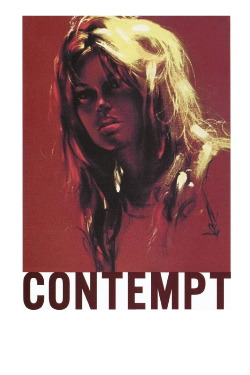
Review of Contempt (1963) by Daniel K — 31 May 2010
4: The novelty of the spoken opening credits is tempered somewhat by the presence of the English subtitles. This obviously isn't Godard's fault though, unless one were to blame him for making his "Hollywood" film mainly in French.
Like his other work, I enjoyed Le Mepris more when I first saw it at Columbia as well. Numerous tricks of his are no longer as effective. Part of this is probably because I'm a more sophisticated film viewer now, but some of it also has to do with the nature of Godard's style.
He was actively trying to break all the rules. However, he only has so many tricks up his sleeve. He's found new ones later in his career as anyone that's seen his work from the last ten years or so can attest to, but Le Mepris functions somewhat as a compilation of his various innovations.
For example, the relatively arbitrary panning of the camera back and forth between the protagonists faces and a lamp, the jump cuts between seemingly disconnected and unrelated scenes, the quick succession of jump cuts, the overpowering and somewhat incongruent score, the disconcerting halts in the music, the quotations from novels, the name dropping of favorite films/directors.
All of these innovations are fairly original, if not in and of themselves, then at least in the style in which they are delivered, but they lose some of their potency, at least for me, after repeated viewings and becoming increasingly familiar with his work.
Godard and Coutard certainly knew what to do with Technicolor widescreen though. There are many startlingly beautiful images, which when combined with the austerity and originality of their delivery and the lush and romantic score, make for powerful cinema.
One of the most striking elements of the film are the absolutely clear cut delineations between each of the three acts as well. Rarely has a film been so textbook in this sense (Bogdanovich's Paper Moon would be an extreme example that is even more so).
Everything about the film is so Godard it's laughable. It would have been interesting to see a Fritz Lang version of The Odyssey, but I'm fairly certain it would look nothing like the one shown here.
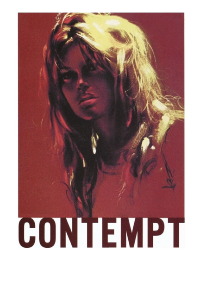
This is also a film about film and filmmaking, which is one of my favorite genres, but then again, essentially all of Godard's pictures are either overtly or sub textually films about film. Bardot is pretty ridiculous.
She's like a voluptuous Barbie that acts like a little girl, at least that's my view of her. I downgraded the film from a 4.5. It is powerful and engaging cinema, but not the kind I'd want to relive over and over or would likely bring to a desert island.
It isn't exactly easy. The two protagonists don't exactly have an easy time communicating with one another either. The ending is still rather magical. I have to think David Lynch has seen it.
This review of Contempt (1963) was written by Daniel K on 31 May 2010.
Contempt has generally received very positive reviews.
Was this review helpful?