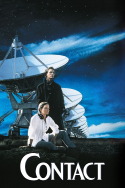
Review of Contact (1997) by Jack A — 31 May 2017
Although Contact may not muster enough vision to keep company with the mother of all sci-fi films, 2001, it possesses something the latter sorely lacked: a character to lend the film its emotional center. The closest 2001 ever came to a likable emotive character was H.A.L. - the monotone supercomputer that could read lips and offed all but one of the astronauts. Of course, this was also Kubrick's intent -- his own ironic jab that perfectly articulated his nihilistic philosophy on man's irredeemable nature. Though in a sense it's not fair to compare the two films, I invite the comparison nonetheless to highlight the yin and yang relationship these two films bear. One is the darker, lonelier and colder view of man's place in the future; while the other posits the more optimistic philosophy that man makes up the smaller part of a larger - and much friendlier - intergalactic community.
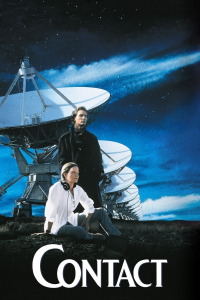
While Kubrick's version is far more compelling, not to mention creepier, Zemeckis' Contact is pure comfort food, thoroughly entertaining and benign. Jodie Foster, as always, delivers a believable performance. As Ellie Arroway, Foster plays a scientist who spearheads an independently funded program to find signs of extraterrestrial life. Just before funding is cut, she receives a strange signal that seems to originate from the Vega Galaxy. When the signal is decrypted with instructions to build a transportation device, supposedly to make face-to-face contact, the find causes a major stir. World governments weigh in, the public and the media are up in arms, trying to make sense of this extraterrestrial message.
While the government screens for likely candidates to be the first ambassador to ride the teleportation machine, Ellie's bid to be that person is thwarted by some key people. Her on and off paramour, Palmer Joss, a minister played by a miscast but not entirely egregious, Matthew McConaughey, questions Ellie's religious faith before a jury panel. As the panel regards Ellie's lack of faith a liability, she loses the candidacy to David Drumlin, her academic rival played by Tom Skerritt.
Without delving too much into plot detail, Ellie eventually gets to finally go on her journey. However, I won't say more except that the theme of religious faith comes to an elegant full circle. The implication that religion and science don't have to be mutually exclusive is a hard won conclusion that Foster's Ellie proves with heart and conviction.
From the start, Contact lets you in on its thematic scope. The opening sequence is a visually sweeping dazzler that firmly straps the viewer right to his seat. Director Robert Zemeckis grounds the story in the present (the film was released in 1997) by splicing in real life events and personages - much like he did in Forrest Gump - to achieve an authentic and visually immediate reality. For anyone who ever gave thought to what might exist beyond our own blue skies, Contact offers an entertaining, ambiguous, but thought provoking ride. It's a movie that suggests we may not be alone in the universe, but we don't have to fear this or feel alone about it. A sci-fi film that can achieve such, is worth occupying a space in my DVD library.
This review of Contact (1997) was written by Jack A on 31 May 2017.
Contact has generally received positive reviews.
Was this review helpful?