Review of Cobra Verde (1987) by Nick M — 20 Jun 2010
Madness in Africa With Werner and Klaus.
I haven't seen all of Kinski's Herzog films; we have two left there. On the other hand, the only not-Herzog film I've seen him in, I didn't realize it was him. (He plays a minor character in [i]Doctor Zhivago[/i].) Most of the not-Kinski Herzog I've seen has been documentaries. Therefore, I cannot say for sure if either man ever managed movies of the quality they reached together, but I don't think such chemistry would have been possible with anyone else. Oh, don't get me wrong--this is the last movie they ever worked on together, and by the end of filming, they were done with each other. I'm quite sure they weren't on speaking terms when Kinski died just a few years later. Herzog knew how to drive Kinski to the depths of madness needed to portray his various megalomaniacs, and the fascination Kinski seems to have held for him created an intensity in filming that is almost stalkerish.
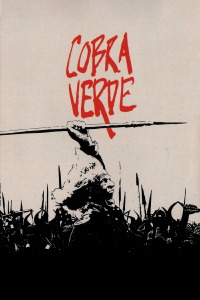
This time, Kinski is Francisco Manoel da Silva, the titular [i]Cobra Verde[/i] (green snake). He is a bandit in the depths of Brazil (again), turned so by the failure of his ranch and the subsequent murder of an abusive boss. He is taken on by Don Octavio Coutinho (José Lewgoy), a local sugar baron, who wants da Silva to oversee his slaves. Alas, that's not all da Silva oversees--he impregnates all three of Coutinho's daughters. In the aftermath, da Silva reveals his identity as [i]Cobra Verde[/i]. Coutinho, in cahoots with several other pillars of the community, arranges to have da Silva go to Dahomey and start up the slave trade between the two countries once more, with everyone pretty much in agreement that they're really sending da Silva out to get himself killed. However, he instead entangles himself in some pretty byzantine Dahomean politics, with various rivals from the throne each trying to take advantage of the willingness of the white man to trade guns for slaves.
I know as near to nothing as makes no difference about the African royalty of the era, though the events don't strike me as all that improbable. Wikipedia confirms that there were female soldiers in Dahomey at the time, so there's that, and mad kings aren't unheard of. The story's based on a book which is based on someone's real life, but the only article of the three with any real detail is that of the movie. However, it does appear true that the real person, Francisco Felix de Sousa, kept trading after the trade had been abolished. And while I'm not entirely sure when the movie's set, the slave trade between Africa and Brazil wasn't abolished until 1850. However, from what I can work out (it's proving more difficult than I'd expected), Portugal abolished slave trade with Africa before Brazil became independent, so I think there was a span of about five years' abolition before it was started up again. And the UK stopped their African slave trade at the same time, so I think that works.
However, as with the other two Herzog/Kinski period pieces I've seen, the history doesn't entirely matter. The real Fitzcarraldo made hauling that boat over the mountain easier on himself than Herzog did. Herzog doesn't know any more about the real Aguirre than anyone else. It's just that the period setting in and of itself sets us outside the world inhabited by these people, so we can look at the people almost as artifacts. It doesn't matter what a historical da Silva would have been like, really. Oh, much of what Herzog shows about the slave trade is, so far as I know, pretty much historically accurate. However, he shows a detachment from what's onscreen. There is a scene where da Silva and another man are walking through a room where slaves have been chained, and da Silva casually steps over a few of them without missing a beat or a word of conversation. Everything is furniture or backdrop except the one man we're supposed to be watching.
It does feel a little uneven, though of course it's still not actually a bad movie. (Herzog must have a bad movie in him; everyone does. I just haven't seen it yet.) At times, it seems as though Herzog is more interested in the scenery than the story. There's a sequence where a message is being sent by semaphore, and we see a whole long row of slaves, shoulder to shoulder almost, flashing their white flags in movements slightly stuttered from one another, the message following its winding course to its destination. This is, of course, silly. For one, it would be hard to see your neighbour's movement that way. For another, that would take an insane number of slaves. On the other hand, it is a beautiful image, and perhaps it's intended to be insane. It's just another example of the profligacy shown by da Silva once he has power, which echoes and is echoed by everything Coutinho does to him. There is also something about Kinski's face which suggests that he's pondering what it might be like to live such a lifestyle himself.
This review of Cobra Verde (1987) was written by Nick M on 20 Jun 2010.
Cobra Verde has generally received positive reviews.
Was this review helpful?