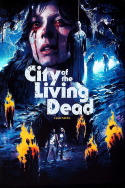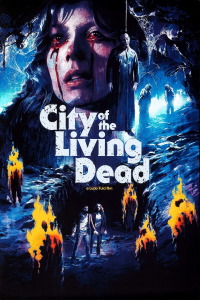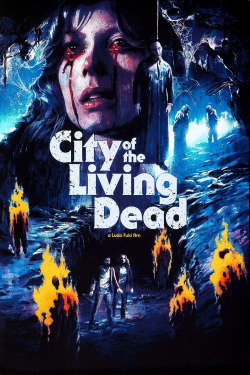
Review of City of the Living Dead (1980) by Chris W — 23 Nov 2012
Lucio Fulci's City of the Living Dead is a masterstroke of deconstructionist cinema that has undeservedly been relegated to the background of the zombie genre, and even more importantly, the world of cinema. What one immediately recognizes while watching are carefully constructed plot holes, tangential editing, and wooden acting in all its gloriously bad forms. Instead of being faults and the wellspring for criticism, Fulci uses them in a postmodern or ironic fashion to play off of other genre horror films of the seventies. This in part explains the near ludicrous plot, which shifts between farce and incomprehensible plotlines. This movie is artistic trash, just as grunge isn?t an accident, it takes hours to perfect the look of stylishly unkempt and cool apathy.
The music, which is similar to other horror films, especially to Fulci?s well known film Zombie 2. There is nothing especially important about the score, only in how it is utilized. In one scene the typical pubescent witness to horror, John-John, is confronted with a zombie, and is saved by the local psychologist. This scene Fulci builds to great effect, a gloomy feeling through his deft use of angles and lighting, and also with his music that usually signifies dread and hopelessness. John-John runs away and there is an edit showing John-John running away. Normally this simple edit goes unnoticed to the viewer, but here it is brought into sharp focus as Fulci drops the music. The effect is jarring, and furthermore Fulci has his viewer focus not on the movie or the emotions it is meant to invoke, but on the construction of the movie and how it manipulates viewers. John-John is safe from the zombies, and the audience is left thinking about the making of the movie itself.
Fulci repeatedly juxtaposes the audiences? expectations of what should be in a horror with scenes that not only fail to deliver, but many times offer an ironic commentary on our expectations. Near the beginning of the film the fortune teller speaks directly into the camera, as though she too is aware this is a film, and says, ?At this very precise moment, in some other distant town, horrendously awful things are happening, things that would shatter your imagination.? Then the scene shifts to an eerie house most perfect for a zombie attack movie, with plenty of openings and an appropriate amount of rustic creepiness. The Fulcian music plays and we see Bob, a mental misfit walk towards the house as a strong breeze blows dirt across the screen. Fulci, the master of mood, with little effort has set up a scene to scare us, to shatter our imagination. But what happens after this setup is Bob throws down a self-inflating woman and laughs to himself. One can almost imagine he is secretly laughing at the audience and their cinematic expectations. Then, as a punchline he looks over and sees a horrific corpse being eaten by worms. As a further joke, Bob becomes a focal point throughout the story, and is the only person that is killed by something other than a zombie.
While Fulci is cleverly deconstructing the filmmaking process he is at the same time creating a dialogue with the Catholic Church. This is plainly evident in that the main zombie is a Catholic priest who converts the people of Dunwich by either wiping foul unholy and unblessed sewage on their face if they are female, or tonsuring them by ripping of the back of their head. The argument at times is pedantic, and overly wrought, but to show the adherents as mindless teleporting zombies voices the concern of the Anti-Christ in sheep?s clothing. The deconstruction coincides with the religious dialogue as a juxtaposition of fiction and faith, and how both are constructed and manipulated. Fulci of course was a devout Catholic, and his commentary is directed at those who are manipulated without having actual faith and/or understanding, and are de facto intellectual zombies. Much can, and should, be written about the religious elements in the Fulci ouvre, and there is far too little space in a review.
At the end, Fulci has the last laugh. He shows John-John running to his saviors, and all the while the music turns sour and then the screen freezes and then, ?Ohhhh God, nooooo!? This is how we are left, laughing at promised, but not delivered expectations, I can only imagine Fulci having the last laugh. In his lifetime he saw his masterpiece, this film, panned by critics as mere gran-guignol and shoddy production values, I hope someday the rare quality of it can truly be extolled by hands less rude than my own.
This review of City of the Living Dead (1980) was written by Chris W on 23 Nov 2012.
City of the Living Dead has generally received mixed reviews.
Was this review helpful?