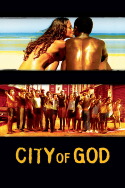
Review of City of God (2002) by Andrea R — 08 May 2011
City of God: From Overlooked to Overrated.
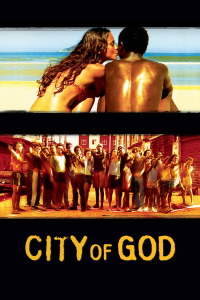
An overwhelming amount of professional critics and amateur movie connoisseurs acclaim Fernando Meirelles' film City of God for a number of reasons. They praise the film for its supposed originality, applaud the brilliant cinematographic techniques, and awe at the ability of the film to continuously keep the viewer's attention throughout the course of over two hours. However brilliant the film may occur to the general public, it is truly far less ingenious and innovative than it is given credit for.
There is an evident lack of originality in the plot, where several characters have endless parallels in other films, and violence is used excessively as a tool to keep the attention of the audience. The inconsistencies and flaws in the story itself are difficult to ignore. The cinematographic camera techniques and non-linear timeline have all been used before as well. It is as though Meirelles took every innovative cinematic idea that had previously been acclaimed and shoved as many of them as he could into two hours of senseless bloodshed.
It is hard to understand why a boy like Rocket is chosen to be the narrator of the film. It seems that if the goal were to show the most genuine "hood" experience, it would make more sense to have the story told by someone who did more than flirt with crime, and played a more essential role within the story, rather than the almost innocent bystander, Rocket. The scene where Lil Dice goes on a blood-lusting rampage, murdering everyone in the hotel, is slightly too appalling and unrealistic. Surely the police would have been notified and on the scene before a kid with a single revolver was able to kill an entire building in an execution style manner. Even without police, the multitude of guests would not sit idly by while hearing continuous gunfire, but would have been able to overpower a small child with no experience with a weapon. Regardless of the stupidity of the guests, he was shooting an old revolver with a 6-bullet chamber. The tender trio did not provide him with extra ammunition, because his only job was to look out and fire a single shot into a nearby window, not to assassinate the innocents, and much more than six people lost their lives. This incident aside, it is even more difficult to believe that a kid like Dice could even grow up to adulthood when it seems that the life expectancy for a hood was so short, especially when they are in a constant state of danger by enemies, a rogue runt with a gun, or even the likelihood of a friend secretly plotting against him for the many sins against his fellow man he committed. Other characters act unrealistically as well such as Shorty, who seemed much too calm to be the kind of person that would violently beat his wife to death for her infidelity, especially when there was plenty of time to consider the consequences in a police infested environment. This list could continue for a while, but it is obvious enough to see that there are various inconsistencies and farfetched events, even for this hostile an environment.
The cinematographic techniques and use of non-linear timeline should not accredit the genius of Meirelles. The primitive handheld camera that attempts to make the viewers feel more in the scene was brought to fame in the 90's with the Blair Witch Project. Although nobody is claiming that this was the first use of that style of film. People applaud this mixture of several different styles, and although just opinion, a film seems messy with an inconsistent style of portrayal. The non-linear timeline was the creation of the great Quentin Tarantino. This has become his signature style in such notable and memorable classics like Reservoir Dogs and the immaculate Pulp Fiction. Meirelles should not be accredited with such high praise just because he attempted to mix a variety of ideas that were the creation of great minds before him.
The lack of originality in the plot is the easiest flaw to notice because it is evident without critical contemplation. There are several parallels to the violence and plot of the "wiseguys" from Martin Scorsese's groundbreaking masterpiece Goodfellas. Rocket is easily comparable to Henry Hill, portrayed by Ray Liotta, for several reasons. Both are first seen as boys in the beginning of the film, who exhibit a bildungsroman as they ascend to adulthood before the eyes of the audience. Hill and Rocket are comparable once more in that both flirt with the life of crime but neither become entirely immersed in gang-life; Rocket as a personal choice and Hill as a man with half-Irish blood, making it impossible for the Italian Mafia to allow him to become into a "made man", which essentially means that he is untouchable within the "family". Both are noticeably more sophisticated, less irritable, and value life higher than that of people they associate with. Rocket is much more reserved than characters like Lil Ze, who is the epitome of evil that the audience is just waiting for to be killed, just as Hill associates with Tommy, the made Italian gangster with a very touchy trigger finger, who's death is also anxiously anticipated. By the end of the films, both understand that they need to remove themselves from that lifestyle in order to survive, showing endless parallels between the two characters, who each share the role of their film's narrator as well. Tommy and Ze have just as much in common. Both are shown in the movie as boys, destined to rise to be powerful and notorious gangsters. Ze was a young boy with a psychological need to kill, and Tommy was a headstrong and irate kid with full Italian blood, creating the possibility of becoming a made man. Both characters manipulated and bullied their way into power as Ze killed anyone he saw as an equal or better, and Tommy pulled the trigger on anyone with the gall to even jokingly insult him. Viewers wait patiently in both films for the two characters to step beyond their boundaries and pay their life as the price, and yet again, both are killed by the unlikeliest of characters. Lil Ze is gunned down by the group of runts after they realize how much power he had just been relieved of, and Tommy is assassinated by men he believed were about to conduct his ceremony of becoming a made man. Whether or not Meirelles has ever seen Goodfellas, it is hard to ignore the many similarities between two of the main characters in both films.
The originality of this film is a mirage caused by an incredibly fast pace that leaves no time to contemplate the plot as it happens, and barely enough to follow the story before another character is murdered. The lack of originality manifests itself in the fact that the storyline of the main characters is all too similar to a number of movies. Much of the story is too farfetched to move past without contemplation of how unrealistic some events are, and the mixture of filming styles that create the illusion of aesthetic innovation until dissected into what is obviously the work of artists before him. City of God is an entertaining, intense, and moving picture, but from a critical standpoint, the many flaws in its story, and the variety of previously used cinematic techniques make this a film that the general public has given an undeserved amount of praise.
This review of City of God (2002) was written by Andrea R on 08 May 2011.
City of God has generally received very positive reviews.
Was this review helpful?