Review of Chronicle of a Summer (1961) by Scott R — 14 Jan 2015
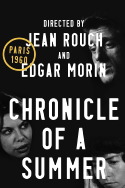
In the film, "Chronicle of a Summer" (1961) by Jean Rouch and Edgar Morin, the truth, with regards to the authenticity of each scene is subtly manipulated by the producers, indicating that Cinéma Vérité films may consist of a mash up of planned and unplanned sequences meant to imitate life specifically for a film rather than showcase natural events. Rouche and Morin fabricate a realistic and smooth representation of life in France by manipulating conversations, cinematography and editing.
Rouch and Morin often cram as many social concepts as they can into "Chronicle of A Summer" in order to have it appear more natural. The film raises many popular issues and concerns in a short amount of time "as part of a larger attempt to craft a 'true' representation of everyday life in Paris" (25). However, the quantity of themes thrust upon the viewer in just under two hours are incalculable and ultimately convey the impression of being forced if not only for the sake of having them present in the film. From the Holocaust and Racism to labor unions and ancient philosophy, the film lightly touches on each, but does not develop any one theme further. A scene only moments prior to that involving the discussion of the Holocaust and Racism depicts piles of newspapers being thrown upon one another with the headings of each paper clearly visible and each depicting something new. Just after the newspaper shot, Morin "deliberately creates uncomfortable tension by questioning an oblivious Modeste Landry about the camp number tattooed on Marceline Loridan's arm" (30). Rouch and Morin attempt to wind the film around the troubles of everyday life, but they try to include so many themes that the film resembles a bombardment of humane struggles rather than a day in 1960s Paris.
Similarly, when Marceline and her friend are wandering around town polling people about whether they are happy or not, it is interesting to hear the responses, but the emotions that the viewer sees aren't always genuine. In general, people's emotions are sacred and are often hidden from others. Typically, In order to truly experience what someone else is feeling, they need to be observed from a distance, not bluntly asked if they are happy.
Direction subtracts from the naturalness of a scene and the films themes are not only manipulated through conversations. Morin and Rouch also incorporate a variety of editing techniques, which allow the film to flow smoothly from one shot to the next. Dilorio discusses that "Chronique is a heavily edited feature which tries to mask directorial intervention. Rather than insist on the cuts from shot to shot, Rouch and Morin place editing in the service of phenomenological transparence" (34). Typically in cinema, a film will appear to flow much smoother as well as be more interesting if it's been heavily cut in comparison to uncut drawn out scenes. "The Chronicle of A Summer" strives to deliver a truthful account of life in Paris, but the editing masks the direction so well that it's difficult to tell which scenes were filmed without direction if any at all. For example when the pin up girl is being interviewed, the film cuts between shots of her interview responses and clips of her walking along the beach and pier. It's often difficult to tell from what shots certain ambient noises are originating or even if they were added in during postproduction. Other times it's quite clear that postproduction led the sound and visuals.
At the very beginning of the movie, non-diegetic Parisian music is played, perhaps as part of the effort to engage the viewer with the Parisian lifestyle. Why then could Rouch and Morin not find the same music from a diegetic source? The fact that the music doesn't originate from within the film and must have been added in postproduction only further provokes the viewer into thinking about whether the film is about Paris or about what Rouch and Morin want Paris to be. Similarly they often took the time to manipulate the final cuts into delivering the messages that they wanted to see rather than what was initially presented to the camera. Dilorio writes, "Some of the cuts were made to focus a discussion that rambled on for over an hour. Others, however, were made to unfocus it: as in the previous scene, Rouch and Morin removed references to specific issues" (35). Dilorio also goes on to mention that Morin and Rouch completely cut out several politics related discussions because they didn't feel the topics were relevant. On the contrary the topics may have been relevant, but were cut because they did not peak the viewers' interests. With respect to time, a true representation of life might have included the less exciting political scenes as well.
Editing and cinematography go hand in hand. With the invention of lighter cameras the producers were able to film more discreetly to achieve a more natural audience rather than one that feels they must perform for the camera. Dilorio discusses that the camera's "reduced size and weight allowed its operator to follow random movement with near-total freedom. Rouch enthusiastically framed the camera's development as a turning point in cinema history: 'We could film in the middle of the street, and no one knew we were shooting except the technicians and the actors" 32. This new technology was used to an effect, but the producers predominantly directed the camera towards their own planned out scenes. Towards the end of the film when Marceline is walking down a long wide street alone and the camera dollies backwards, it is clear that careful planning of the shot was involved. Even though the producers had this light discreet camera to naturally film other people, they often opted to film themselves in their own homes or carrying out their own daily activities such as getting ready for bed or practicing martial arts in the backyard. Overall, they missed out on a lot of the potential that a smaller discreet camera provided them with.
A true to life film is simple and lays everything down for the viewer to see and hear. "Chronicle of A Summer" does nearly the opposite by editing around or manipulating conversations to derive new meanings. While the film is interesting to a wide audience due to its fast cuts and plethora of themes, "Chronicle of a Summer" and Cinéma Vérité as a whole do not always present the whole picture and thus do not present the whole truth, rather it favors what must be done to appear more interesting to its audience.
Bibliography.
Dilorio, Sam. "Total Cinema: Chronique d'un été and the End of Bazinian Film Theory." 2007. Oxford Journals. Screen 48.1: 25-43. Concordia University. Clues Library Catalogue. Maule, Rosanna. FMST 322/3 Course Reserves. October 12, 2014. Web.
Maule, Rosanna "Cinéma Vérité and Ethnographic Cinema: The Look on the Other." FMST 322/3 Classroom Discussion. Concordia University Library Auditorium, Montreal. October 2, 2014. Lecture.
This review of Chronicle of a Summer (1961) was written by Scott R on 14 Jan 2015.
Chronicle of a Summer has generally received positive reviews.
Was this review helpful?