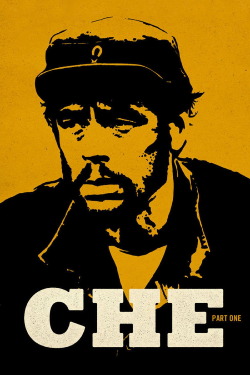
Review of Che: Part One (2008) by Paul Z — 07 Oct 2009
Che Guevara is ordinarily portrayed either as a martyr of rebellion, or a cold-blooded butcher. Steven Soderbergh's monumental profile of him doesn't feel the compulsion to pigeonhole him. It is also not written from the perspective of record, but from Guevara's own point of view on a regular genesis in the course of conquering the Batista regime in Cuba and then struggling in vain to duplicate his accomplishment in Bolivia. Both parts of the film are based on his writings, including a diary in Bolivia written on the go, one day at a time.
Soderbergh, whose diverse body of work and studious craftsmanship are purely distinctive among contemporary filmmakers. He does not preoccupy himself with proud auteurism or an unshakable throughline of recurrent themes and subjects. He just keeps on working, and there's never a question that it's his movie. There is a sign of great patience and workmanlike attitude in a director who effortlessly shifts in and out of Hollywood and purely independent modes. In either case, though some of his films are vastly superior to his others, he is always refined and articulate. He has written, produced, shot, edited and directed Che, this 4-hour two-part biopic of a Marxist revolutionary at a time when neo-conservatives have returned to their old exploitations of socialism and communism.
The Argentine of Part One's title is played by Benicio Del Toro with chameleon-like fluency, using very few words on screen and exuding an incredibly real physical performance. He is the whole film. He is what immerses us. In an unprecedentedly discriminate and disciplined approach by the one-man crew of a director, it defies the hankering to pump up the volume, to silhouette Che against the horizon, to cover customary biographical rudiments. In Cuba, we accompany him in the middle of things. We learn that he is a doctor, but not how and why he is one. It is self-evident that he is a revolutionary. He is a genuine guide. Fidel Castro, played by Demian Bichir with a kind of inherent hero worship subdued by Soderbergh's cold, shrewd eyes and ears, is his friend, but the film does not show them in a developed accord as most of the time they are separate.
This seminally important movie, both parts, is all in the present tense. Che has made an immutable resolution to dethrone governments, he describes why in his accounts of inequality, he relates to menial laborers and not with his own ruling class, and although he is theoretically a socialist, we do not hear much discourse over principles and philosophy. He is a practical communicator with a deep common sense and the capacity to turn ideas into realities and to translate experience into words. He appears thoroughly fixed on the responsibility directly before him. His modus operandi is to make known the prevailing bitterness towards a dictator, earn the loyalty of the people and dishearten conflicting armies of apathetic soldiers. He doesn't require many men because he has a compelling precept behind him. In the end the movie isn't categorically about a hero but about the system of guerrilla warfare, the day-to-day mechanisms of an insurgency.
This review of Che: Part One (2008) was written by Paul Z on 07 Oct 2009.
Che: Part One has generally received positive reviews.
Was this review helpful?