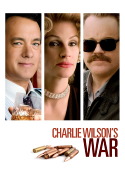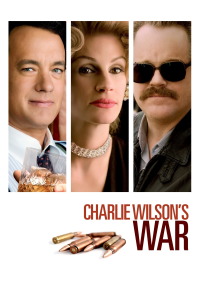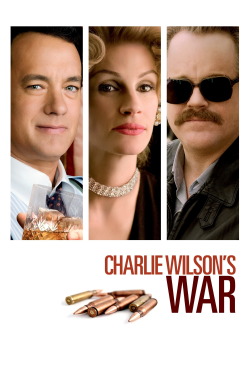
Review of Charlie Wilson's War (2007) by Corey N — 25 Jun 2009
Philip Seymour-Hoffman has arrived. As CWW?s wise but ill-fitting CIA analyst, he?s a finally matured, sardonic powerhouse.
Certainly, CWW enjoys an impeccable cast and terrific performances, inspired by such a generous Aaron Sorkin script. John (Where?s Marlowe(1998), ?Mad Men?(TV)) Slattery's timing is pitch-perfect dancing with PSH, while Denis O'Hare is the perfect "massive tool" and Om Puri the most measured/culturally accurate "straight man" in the "Pakistani Vaudeville Team". Ken Stott(?Rebus?(TV)) is seemingly cast for his deadpan reactions and the silly timbre of his voice; this plays against the fear the mere mention of Mossad typically invokes in their Western counterparts.
James Newton Howard's evocative score deserves special mention for always setting tone so well, especially during the opening MiddleEast-to-Arlington transition. From this point in 1993, the narrative starts in earnest with a linear flashback from 1980 onwards.
Post-TV, Sorkin sought another outlet for his complex scripts. Based on Crile's 10-yr-long agonised-over novel, this relatively short screenplay even delivers some of the snappiest dialogue in the business, but ITS ENDING is let down in editing.
CWW's ?dramedy? balancing-act hinges on successfully depicting a flippant and unethical playboy/Congressman from Texas as lovable as the real man was. Complicating this, the screenplay had to extend to the burden of hindsight, but it's UNreasonable for audiences to provide that for themselves.
Although in the last 2mins of the main narrative Tom Hanks tries in his close-ups to project Charlie's sense of failure about "the end game", the screenplay and editing needed to do more. This was, after all, the raison d?etre of the film! Instead we?re allowed to perceive the film?s truncated nature when a PROPER explanation for Charlie's crucial hindsight quote turns out to be missing. The story just fades out, unfinished after only 90mins, while the book-ender clangs it shut with Charlie's receipt of his "Honoured Colleague" Clandestine Services(spook) award. Consequently, Sorkin's cinematic adaptation plays as watered-down, and the closing book-ender too pat.
George Crile's 416-page same-titled book first noted that Charlie"...had a genius for getting people to judge him not as a middle-aged scoundrel, but instead as if he were a good-hearted adolescent, guilty of little more than youthful excess. This survival skill routinely permitted him to do things that no-one else in Congress could have gotten away with". This of course was the key that unlocked Tom Hanks' characterisation, but it also presented Hanks with a career risk, because Charlie's misbehaviour was grossly at odds with the actor's persona. The film therefore gently pillories Charlie?s legal selectivity: when the strippers yell "We love you, Charlie!", Hanks mumbles "Oh, it helps not to know me". Charlie's warts-and-all portrayal is further peppered with his crass expressions--eg "I like drinking women and chasing whiskey"--which Hanks cleaned up for the final cut.
Largely due to the alchemy of Hanks' acting talent, the central conceit of Charlie's "likeability" succeeds, and completely sells the story to audiences who have never heard any of this before, but a few additional elements do fail: Hanks' "Were you listening at my door?!?" line, for instance, delivered 3x, totally disrupts the pace just to ramp-up Gust's "Don't be an idiot, I bugged the scotch bottle" payoff. (Perhaps they couldn't slow Seymour-Hoffman down with a preceding "Hell no"). Hanks also overindulges the "...shoot down the helicopters" line to prod the audience to that conclusion.
The film?s light-hearted tone sometimes replicates Eddie Murphy's equally funny The Distinguished Gentleman(1992). They both make laugh-out-loud observations about the pure banalities of Congressmen surviving a rarefied pyramid scheme swimming with sharks but sometimes voting on issues as trivial as continued DoD support for Boy Scouts!
The early scene with "Larry"(Peter Gerety, in a hugely satisfying caricature of an overbearing, corrupt "contributor" who came to Washington to "influence" a Congressman WITH his daughter--that's her in the shirt and heels), is crucial for establishing the haughty Texas persona that even Charlie Wilson shared. His bedroom scene with the newly introduced Joanne Herring(Roberts, now an often overfamiliar recourse) further reveals not only her deep relationship with Charlie (who owes her his seat in Congress), but that she isn't above manipulating his electorate as a "contributor" either. This then is the "Helen-of-Troy" face of corruption of the American legal system.("One voate? Vhee hav menyi voates"...).
This famously "easy man to like" proved to be a surprising White Knight while nobody was looking (Gust: "As long as the press sees sex-and-drugs behind the left hand, you can park a battle-carrier behind the right hand and no-one's gonna f!cking notice"), but sadly his $billion-funding bogged down with superpower loss-of-interest for nation-building. Since career intel officers have occasion to know the "bouncing ball" of consequences only too well--they call it "blowback"--Avrakotos successfully convinced one lone Congressman that rebuilding Afghanistan was even more vital than kicking the Russians out was.
The film's actual CIA consultant was the astonishingly personable and sincere(!) Milt Bearden, who has himself suffered personal losses at the hands of terrorists over the last 25yrs. Many CIA personnel names are real, but CWW's Islamabad station chief seems to be named after the Australian Prime Minister who in 1967 disappeared in surf, his body never found. The film's wink is that he turned up in Pakistan 13yrs later wanting clandestine revenge for Vietnam.
Thus Sorkin personalises the spooks while giving away little-known CIA history. Chief tidbit is how President Carter's DCI, Admiral Stansfield Turner, during his 1977-1981 tenure shockingly dismissed 3,000 career CIA officers alleging their "unpatriotism". This truly controversial decision left the remaining spooks mostly "old school" Princeton Ivy Leaguers--implied by Gust's line "...you poncy schoolboy"--but it also rendered toothless the CIA's "humint" apparatus. Coupled with subsequent politicisation of the remaining "sigint" capability, this decision has since delivered America its embarrassing "intelligence failures".
?Less? is just less.
Unfortunately, the surviving Afghani orphans of war, in the absence of society/hope, would grow up as easy converts to fundamentalism and be the fresh supply of dispossessed angry-young-men that the "unspooled" Islamists need(ed). Spooks and diplomats will tell you that he best defence against terrorism is to disallow its fertile ground (prevention), no matter what non-secular text the unspooled are thumping. Such socio-economic investment--Charlie's concept of the ?end game?/?exit strategy?--should never be left to one Congressman to convince a nation. Perhaps this true story (cf Woodward, Bob(2005) Veil--The Secret Wars of the CIA 1981-1987) finally reaches America?s "patriots?. As too passionate haters of opposing political systems, patriots usually don't understand that THERE ARE WORSE THINGS. Presidential catchphrases ("the Evil Soviet Empire", "Axis of Evil") too should carry "BUYER BEWARE" disclaimers.
Missing that, CWW shows Joanne Herring(Julia Roberts) being thoroughly cynical as she manipulates Doc Long(Ned Beatty) in Peshawar for money, but claims she only uses the religious talk because (...it works)/they "need God on their side". Charlie's cold-water comeback is a brilliant warning we must all heed: "What's got Gust worried is that pretty soon God will be on BOTH SIDES!"(...because everybody will be dead).
Ultimately, compared to Sorkin's TV work (West_Wing, Studio_60_on_the_Sunset_Strip), CWW is a little bellow par--for him. On the other hand, Charlie Wilson, the "immature" ?Congressman from Kabul" actually deserves credit as a modern-day Scarlet Pimpernel. After 5 meaningless re-elections he finally found a sobering cause.(8/10).
Lizziebeth-1, IMDb.
Sydney.
This review of Charlie Wilson's War (2007) was written by Corey N on 25 Jun 2009.
Charlie Wilson's War has generally received positive reviews.
Was this review helpful?