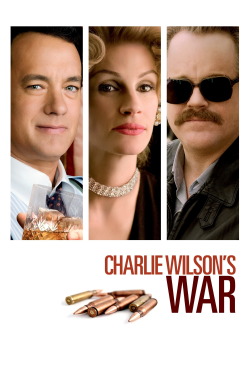
Review of Charlie Wilson's War (2007) by Andy T — 19 Oct 2015
I love the kinds of political films that delve into the details of a hugely important, yet forgotten, sequence of events that skirted days past. Like Ben Affleck's "Argo," where we were informed of an audacious hostage escape during the Iranian revolution of the 1970s. Or 1976's "All the President's Men," which reminded us that the revelation of the wrongdoings at the Watergate complex took a hell of a lot of intricate stirrings of investigative journalism. There's a certain sort of kick you feel after leaving the theater enlightened, as if you know a secret only a select few have been told to keep quiet themselves.
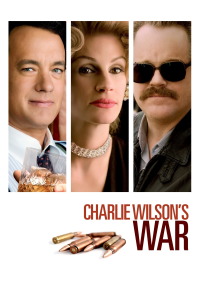
"Charlie Wilson's War" is such a film, detailing the process by which its titular congressman endured in order to further his very own Operation Cyclone, a government funded program meant to support the Afghan mujahideen during the brutal Soviet-Afghan War. Capturing events beginning in 1980 and continuing on until the end of the decade, the film is as eye-opening as it is sharp - it's a political comedy unafraid to tread into deeper waters, and that's what I like best about it. It doesn't hurt that Aaron Sorkin, the man behind "The West Wing," is writing, either.
As the film opens, Charlie is introduced as a hero, an above average politician receiving a medal for his bravery - we briefly flirt with the idea that he may very well be an American hero. But when the movie flashes back and tells its story from the very beginning, it is revealed that our hero is more flawed than any moviedom protagonist has any right to be. We discover Charlie is a congressman who doesn't take his job very seriously, a smart cookie with a questionable fixation with cocaine, liquor, hot tubbing with strippers, and staffing his office with sex bombs; to him, legislating is a bore, a way to earn endless amounts of money. Changing the U.S., let alone the state he represents, Texas, for the better is a job for someone else. (Good thing he's portrayed by the most likable star of the past thirty years - then we'd be in trouble.).
Charlie's interests in politics are suddenly piqued once again, however, when his friend and lover, socialite Joanne Herring (Julia Roberts), brings the Afghan conflict to his attention. From there, he continues to womanize, to drink; but changed is the way his life suddenly has purpose. After seeing the situation for himself, he is partnered alongside CIA officer Gust Avrakotos (Philip Seymour Hoffman), a grumbling cynic who aids him in what we now know as Operation Cyclone, which, ultimately, dramatically increased government funding toward anti-communist action.
"Charlie Wilson's War" is better when its factual side is tucked away and characters partake in verbal combat - like all of Sorkin's work, there is something exciting about watching conversations and berations, a quality not as prominent in cinematic entertainment as I would like it to be. I could listen to his characters speak for hours upon hours; when the central story comes around, it's almost a party crasher. The true story, news cycle-esque, is more informative than it is exciting; we have more fun when basking in the exchanges of the actors.
Hanks, unsurprisingly, makes a supremely flawed man walk around with staunch charisma; Roberts and Adams are luminous as the women most important in Charlie's life. But the film belongs to perpetual supporting actor Hoffman, whose portrayal of Avrakotos jumps out from behind the screen and punches us in the throat.
"Charlie Wilson's War" also serves as the final directing credit of the legendary Mike Nichols, the artist behind such masterpieces as "Who's Afraid of Virginia Woolf?" and "Silkwood." So of course "Charlie Wilson's War" seems minor. But it's a dependably witty way to go, and the actors, and, of course, Sorkin, are incapable of half-assing anything.
This review of Charlie Wilson's War (2007) was written by Andy T on 19 Oct 2015.
Charlie Wilson's War has generally received positive reviews.
Was this review helpful?