Review of Chappie (2015) by Nightreviews — 09 Mar 2015
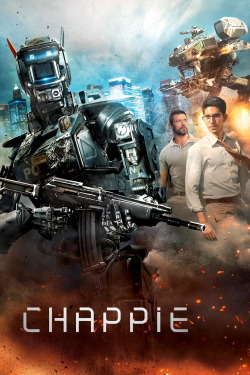
A sense of belonging seems to be writer/director/producer Neill Blomkamp’s greatest asset when it comes to filmmaking. The man behind the revered District 9 picks up the pieces of his fumbled second feature film Elysium by introducing us to the second cutest robot to ever grace the silver screen, Chappie.
If you are wondering who managed to snatch the first place title of cutest robot to hit the big screen, I would easily argue Wall-E as the clear champion, albeit, animation (as well as Disney) have a fantastic way of bringing out the cute in everything, even a teapot. Luckily for audiences and movie-goers, Chappie is different; Chappie is real: Chappie is alive and Chappie is very much one of the best things to happen to the year 2015 in film.
Blomkamp again introduces us to a world not far off from the one we live in today. Launching his story in his hometown Johannesburg, South Africa, local police are shown to have begun implementing a robotic policing force, known as the Scout program, from a weapons corporation Tetravaal. Its creator, Deon Wilson (Dev Patel), has been successful in creating easily operated and incorruptible weapons for the greater good, but we quickly learn that Deon is in search of something more – artificial intelligence and the creation of the first living, feeling sentinel being.
While Blomkamp’s film relies heavily on action, visual effects, and character development, Chappie can easily be hailed as the director’s most personal, emotional, and sentimental feature film. Never shying away from very real and often times imaginative social commentaries set within uncomfortable and contemporary political setting, Blomkamp wastes no time in introducing Chappie, developing his character as much (if not more) than any other human being seen on screen.
Hot off the heals of a very painful and personal failed program, ex-soldier turned engineered Vincent Moore (Hugh Jackman) is persistent to prove Wilson’s Scout program as a failure, never being able to trust or rely on artificial intelligence. Deeming the program unpredictable, and arguing the ethics of A.I with that of a human being and the morality, ethics and fine fabrics that make man, Moore sets up the film for its greatest and deepest commentary. The very essence of Chappie relies heavily between the conflicts and struggles of two very real people: Deon and Vincent, and how their creations used for the greater good become catalysts to eliminate crime in a violently filled South African capital. Yet, throughout Chappie, the greatest animalistic behaviours and torn examples of violence, inhumanity and injustice/crime are seen by human beings. Moore spends most of the film trying to deceit and ruin Wilson, from nothing more than we can understand as revenge and jealousy, allowing us to pose the questions: would we want this man governing and policing our streets? Are these the beginnings of corruption?
In addition to these scenes of treacherous human behaviour, the realest and most humane scenes of the film are those, almost exclusively, involving Chappie. From a quiet and sad encounter with a dog, to a very confused and apologetic encounter with a bleeding police officer on a bridge during a heist, to his many interactions with his “maker” Deon, Chappie shines with the most unwavering signs of humanity and moral justice.
The underlining context of Blomkamp could easily be observed for many viewings, which makes Chappie, a robot with a bright orange “reject” sticker across his forehead, one of the most brilliant and under-apprecaited films of 2015, deserving of being seen at least twice.
Thankfully, although Chappie may be credited as being the most human character in the film, despite the simple fact that he is indeed a robot, he is not the only interesting individual. Endearing robot aside, Blomkamp’s emotionally rich and deeply subconscious film is filled with fascinating characters. The two roles bound to be the most talked about make up the duo that will determine whether or not people enjoy the film. Of course, the pair is none other than Chappie’s Mommy and Daddy: Ninja and Yolandi (Watkin Tudor Jones and Anri du Toit or, better known as, Ninja and Yo-Landi in the rap/synth South African musical duo Die Antwoord). Quite possibly the biggest reason Chappie may not be a success nor treated as the bravest science fiction film of 2015, is the inclusion of Die Antwoord. As it was for myself once I got wind of the casting choice, their involvement may be a real mystery to viewers. Truthfully, I wasn’t fully able to understand their significance being cast up until the rolling of the end credits, ironically enough, while their song Cookie Thumper! penetrated my ear lobes. Blomkamp, a master filmmaker whose obsession with analyzing and capturing the essence of reality and significance of his hometown upbringing, truly brings a unique commentary about lower class societies and gangster culture.
This review of Chappie (2015) was written by Nightreviews on 09 Mar 2015.
Chappie has generally received mixed reviews.
Was this review helpful?