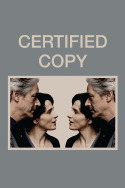
Review of Certified Copy (2010) by Derek C — 20 Mar 2011
3.5 Stars out of 4.
I started to watch Abbas Kiarostami's Certified Copy late at night. After almost an hour, I fell asleep and felt unimpressed. What was it all about? The next morning, I finished it and was riveted. It transformed through my dreams.
I say that unpretentiously because Kiarostami has been called a filmmaker who causes his audiences to "sleep during his films and dream about them afterward." I think that is because Kiarostami does not answer our questions and inspires our thoughts. He hates reaction shots and loves to show what isn't often seen. Boring? No way. It is intoxicating how Kiarostami creates his ambiguities and shoots the action as if they are reflections in a mirror.
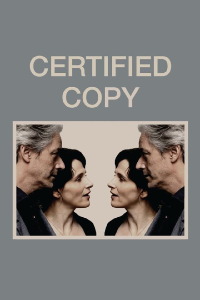
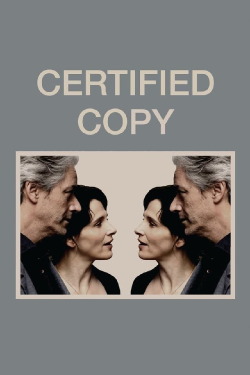
Certified Copy, unlike Kiarostami's previous films, was shot in RED and not his typical digital camera. The film stars Juliette Binoche, a venerable French actress Kiarostami has had his eyes on since the 1990s. She had appeared in his experimental called Shirin and entered the world of Certified Copy convinced that it was a personal anecdote of Kiarostami's. That pervades her performance in the film, as Binoche has a relaxed sensitivity to her character 'She' and a passive attentiveness to her that makes her a part of the story, while also just listening to it.
Kiarostami was known for hiring non-professional actors like the neo-realists did. He wanted to avoid the semblance of "acting" and make his films more real-life. Binoche is his first professional actress and her non-professional costar is stage actor William Shimell, an essayist named James Miller promoting the copies of art. The two rendezvous in Tuscany and endure a day's trip through the utterly beautiful landscape encountering events that are more equivocal: they realize they resemble much of a happy couple and start to reenact a married couple. Gradually but also very suddenly, we start to wonder if they are actually married. Odd.
This is the first time Kiarostami has filmed outside of Iran. His previous films, such as Close-Up and Through The Olive Trees (the only other Kiarostami I have seen), frame the action in ways uncommon to the average movie watcher. The director avoids "important" reaction shots because he would argue they aren't. The audience has seen enough movies and know it is human nature itself that allows the audience to extrapolate how the other character is reacting.
Consider this scene: in the opening, James Miller is discussing his latest work and She watches him from the crowd, while her son sits in the corner impatiently. After a long medium shot of James talking, Kiarostami cuts to the 'world' of She and her son. She tells him to behave and the boy gets more grumpy. What Kiarostami does is thread a series of dramatic moments (I use "dramatic" as nuanced actions not explosions) depicted from a point of view that makes us wonder how another character would react. Wouldn't James be aggravated by the boy disrupting his presentation? We have to assume; Kiarostami will not tell us.
That scene defines the pattern and purpose of Certified Copy: Kiarostami evades truth. There is no fun in knowing everything, which is probably why audiences tend to sleep blissfully in his films. His questions exhaust them and then the audience wakes up revitalized and intrigued as new spirits. For decades, directors have strived for obtaining an objective reality to enhance their credibility. Kiarostami revels in the subjective, while creating characters that represent fundamental emotions on a universal level.
The film has this genius gradual pacing that, even when Kiarostami cuts, seems to exist within the same place and time. This is the power of Certified Copy: we lose hold of She and James's identities - but when? The performers are so good that their character transitions seem natural and subconscious to the point that none of their changing behaviours are contrived.
Certified Copy represents much of Michael Haneke's Caché, which also starred Binoche. The plot is completely different, but the camera style frames the action so we do not know how to interpret reality. In Caché, the image in the camera were the ambiguous worlds, whereas Certified Copy reflects gestures and personalties of people and forgets what order they are arranged.
It is not a very intricate message. In fact many people may wonder what the point is or why we should care. I would argue existentialism has always been a philosophy that is not inherently significant, but it is made important the more we wonder about why we live. Many are afraid to inquire about that. The characters in Certified Copy are important because humans are too, and it seems we can learn much about ourselves and what true personality contains us.
The Tuscany landscape is such an allurement and ridden with so much happiness that it is a great irony to the insecure chaos imploding on She and James. Certified Copy, therefore, reminded me of Rossellini's Voyage To Italy, about a couple making sense of their love across a romantic land.
Certified Copy starts as a joke on love with the typical Kiarostami car conversation scenes (with the city being reflected in the front window like paintings of the world beyond the automobile) and the characters treating their new-found relationship with levity. Soon, emotions flare and we are not sure if this is a disorderly couple trying to make sense of their marriage and human essence.
So many questions are raised and few are answered. Kiarostami asserts: "The only thing that I can do is hold a mirror in front of men and women, in front of the viewer in the theater, to reflect." Yes, that is true. Certified Copy is an analysis of relationships. How some come, go, and if they ever were. By the end, Kiarostami strands us in a very Caché-esque conclusion, in silence that almost envelops his enigma.
What we are left to wonder is which layer of existence is She and James's true certified copy?
This review of Certified Copy (2010) was written by Derek C on 20 Mar 2011.
Certified Copy has generally received positive reviews.
Was this review helpful?