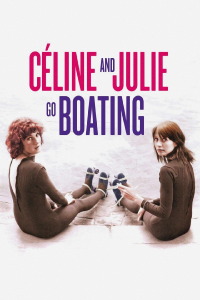
Review of Céline and Julie Go Boating (1974) by Eric B — 29 Mar 2011
Sort of a cross between "Alice in Wonderland" and "Rosencrantz and Guildenstern Are Dead," "Céline and Julie Go Boating" is a peculiar film that defies convention in multiple ways. Even its length (192 minutes) is a challenge. "Surreal" is an overused term, but it certainly applies in this case.
The story opens with Julie (Dominique Labourier) sitting in a park. Tellingly, she is reading a book about magic. A confused-looking woman (Juliet Berto, best known for various Jean-Luc Godard films) stumbles past and drops her sunglasses. As helpful Julie chases after her with the retrieved glasses (the Alice/White Rabbit parallel is intentional), the woman lurches through the streets and drops further items. Soon, we realize that she's knowingly teasing.
Julie and the woman we eventually know as Céline engage in these hide-and-seek games for several scenes, but finally engage each other in conversation. Céline moves into her new friend's apartment, and the giggling begins.
This odd bonding ritual is drawn out for over an hour of screen time. In fact, 11 minutes pass before anyone even speaks. Some background information emerges -- Julie is a librarian, while Céline is a cabaret magician -- but the central plot takes quite awhile to emerge. Accordingly, this is a film where reading a few reviews beforehand can be a major help. Because otherwise, you may need to watch it again. And remember, it's over three hours.
Bearing this in mind, take some advice: Be patient through the first third, because the heart of the story is not so much about the two women's relationship. Or their giggling. The real intrigue begins when they start sharing visions of a past saga within a large, nearby manor. Widower Olivier (director Barbet Schroeder, demonstrating why he didn't make his fortune as an actor) has a young, sickly daughter named Madlyn. His sister-in-law also lives in the home, and aims to win the vacant role of wife and mother. Another resident female, employed to watch Madlyn, shares the same competitive goal. However, there's a problem: The departed wife made Olivier promise not to remarry, for fear of disorienting their child.
A live-in nurse treats Madlyn and, more importantly, serves as the portal through which Céline and Julie observe the family tensions. She is alternately portrayed by both Céline and Julie during these scenes. This is not the only blurring of the two's identities -- they intentionally impersonate each other for sport at other times.
A crime occurs in Olivier's home, and the two eavesdroppers seek to find who did it and, if possible, to intervene before it happens. The story leaves realism further and further behind as it unfolds. Additional spoilers should be avoided, but do pay close attention to appearances of hard candy.
This can be a wearying film -- did I mention the giggling? -- but it turns more engrossing as time passes. In fact, the final half-hour is so delightful that previous frustrations are mostly forgotten. The ending is perfection.
Jacques Rivette's direction is an abrupt clash of styles, in accordance with the two parallel tales. The contemporary scenes have the loose, documentary-like rawness of the French New Wave, while the manor sequences are almost gothic in comparison. The performances of Berto and Labourier are equally jarring when matched with the actors in the fantasy. Meanwhile, there is essentially no musical score. It's a tricky mix -- part old-fashioned melodrama and part Luis Buñuel-like surrealism. Perhaps it's no coincidence that Buñuel made "That Obscure Object of Desire" just three years later, casting two actresses to portray a single domestic worker. Sound familiar?
This review of Céline and Julie Go Boating (1974) was written by Eric B on 29 Mar 2011.
Céline and Julie Go Boating has generally received very positive reviews.
Was this review helpful?