Review of Cat People (1942) by Clément L — 27 Jul 2008
The most famous Val Lewton picture overall I do believe, and one that has suffered ruination in my past--some documentaries saying "Watch now, this tense scene from Val Lewton's Cat People..." This is one of the most frustrating ways to see anything, as you cannot regain the surprise of context for films, which is part of the reason, I suppose, that I watch what I want when I want to and don't watch television--nothing to be ruined except unintentionally by my own hand, or perhaps, luckily, I will see references retroactively without having had them ruined, and simultaneously enhancing my pleasure in them through associations.
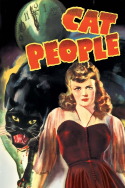
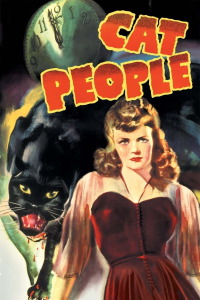
Irena Dubrovna (Simone Simon) is a Serbian immigrant, working as a fashion designer in America and first seen sketching in front of a black panther's cage in a zoo, repeatedly tossing abandoned sketches, crumpled, into a nearby trashcan--except her aim is poor, and they land at the feet of Oliver Reed (!, not played by the then-five-year-old Oliver Reed, but Kent Smith), who designs ships. He walks up to her and begins to, as they say, "chat her up," and after some reluctance she eventually decides to give into the temptation he presents and invites him up for tea (not in the Eddie Izzard coffee invitation sense though) and the two begin to spend a lot of time together--declaring their love for each other a mere fifteen minutes into the film (!) but now Irene must reveal her fears about the legends of her village. In it, people began to "worship Satan" and practice "witchcraft," eventually leading to the razing of the village by King John, leaving only the most clever of these evil souls to survive in hiding. They were later the "cat people"--women who would turn to big cats in the throes of passion and rend their lovers to pieces. Irene fears this deeply and so keeps a distance from her husband, whose showing concern over the issue makes itself apparent to his co-worker Alice Moore (Jane Randolph), who breaks down and confesses her love to Oliver. Now, with the help of psychiatrist Dr. Louis Judd (Tom Conway) Oliver must try to save his wife from her superstitions and thus save his marriage. Unfortunately, her fears are too strong and she skips out on therapy, still hypnotized by the black panther we first saw her with. Now it's the tension of Irena's feelings of Alice's threat of closing in on Oliver while she tries to overcome her own fears about the legends she was raised with, which she cannot shake her fear of.
Simon's French accent is thoroughly noticeable but easily dealt with by the logical plotting of a foreign character, while Smith is sufficiently conflicted in figuring out how to deal with a woman he thinks he loves who keeps so far from him, and Randolph manages the "best friend who has actually been in love with the protagonist the whole time" shtick quite well, too. Much is made of Lewton's subtlety, including by me in previous reviews, but studio interference ruins it in this film--there is no debate, as the movie is shown, as to whether the superstition is real. It's actually even disappointing when the question vanishes. This doesn't distract from the artistic skill of the film, Jacques Tourneur's skillful direction and the fast clip of its pacing keeping even a fifteen minute-in declaration of love seeming temporally reasonable, establishing passage of time clearly but not clunkily. The noir-esque shadows filling the film (and often hiding the panther that, but for the studio's ham-handedness, may or may not be there) add just the right element of confused mystery, as you are often seeking out the image--is it Irena in the shadows or a cat?--only to find nothing but darkness, looming mysterious shapes and the shifting of them as light plays off different objects and casts different shadows--especially in the infamous pool scene.
I take some issue with the film's character approach, even as I applaud it--I had similar issues with Bedlam, which came later--because I found myself suffering a great distaste for everyone around Irena, who was originally to be left alone, only to be swept up by Oliver, who then decides to leave her for another woman, even as she has asked for time and he has promised it. Alice's "Oh, I've loved you from afar...!" is almost nauseating--couldn't she have said something before the stupid sap was bloody married? And of course the rather lascivious and morally suspect Dr. Judd, who seems intent on prescribing a treatment for Irena that would be termed malpractice without question by most souls. And then, of course, we have the studio's interference--now, somehow, the fact that we know the truth of the curse (rendering any idea of mystery around this moot, and retroactively setting the movie in a world where it isn't a question) means that, indeed, Irena is, in some respect, an uncontrolled evil. This sucks far too much sympathy away from a truly tragic figure, abused by a quack of a shrink, left by a husband for a woman who recommended her shrink, and that husband, too, sharing these intimate details with his "just a friend" female. It's awful to watch these people around her--and it feels like a slap in the face to be denied even the possibility that these acts were performed by a woman lost and confused by superstition--now it was inevitable that if her husband had kissed her, she'd have mauled him, so good for those two irritating lovebirds who ruined her, because she was already ruined.
But, to have this reaction, I suppose says something of the quality of the film, though it really says more of the loss suffered when the studio insisted on more panther footage and an accurate "horror" billing that meant clearly defining the curse as true. A shame, but one that does not, again, distract from the quality of the work put into it anyway.
This review of Cat People (1942) was written by Clément L on 27 Jul 2008.
Cat People has generally received positive reviews.
Was this review helpful?