Review of Casino (1995) by Brandon S — 06 Feb 2014
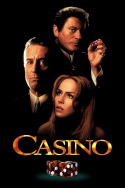
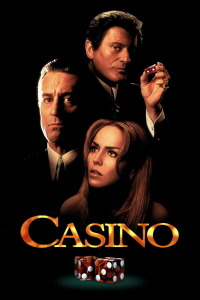
There is simply no better tandem in film history than Martin Scorsese and Robert De Niro. The buzz about GoodFellas was still going strong when Scorsese finished a mafia classic based on yet another Nicholas Pileggi book and featuring many of the same actors as the earlier film. Casino is the story of the rise and fall of the Tangiers, which was bankrolled by mob bosses and managed by sports handicapper and Vegas innovator Frank "Lefty" Rosenthal. The film renames him Sam "Ace" Rothstein, with De Niro in the lead role. Joe Pesci plays a similar character to his trademark performance in GoodFellas. In Casino, that character is Anthony Spilotro, who was renamed Nicky Santoro. The similarities in genre and cast force unavoidable comparisons between the two Scorsese classics. Since GoodFellas came first and told a much simpler story about mob loyalty, it is often credited as the better film. But Casino is superior in many ways that are rarely acknowledged. The scope of the story is more epic and powerful; lighting and camerawork are more innovative and artistic, the editing is executed more brilliantly by longtime Scorsese associate Thelma Schoonmaker; and the wardrobe, sets and landscapes are more impressive in Casino. The soundtrack is more varied, too.
Casino follows GoodFellas' formula of showing a defining moment of the story before the opening credits roll. In this case, we see Ace walk into his car, get in and turn the ignition. The car catches fire and explodes as De Niro's narration reveals that Ace once gave someone the key to everything he owned and he thought he had the kind of love that supported that trust. This dramatic opening segues into the credits that appear over kaleidoscopic Vegas lights with the form of Ace's body tumbling through the air. The narration - a tag-team tour de force between De Niro and Pesci - explains how Ace and Nicky came to Vegas after establishing their reputations back home, and how the mob bosses bankrolled the Tangiers. Through the introductory segments of the film, the camera never stops moving. De Niro and Pesci share narration duties and their voices lend clarity and authenticity to the plot. Pesci in particular adopts a flawless Chicago accent and never breaks character. His performance is gripping in its volatility, just as De Niro's is masterful in its restraint. The supporting cast, including Sharon Stone, Don Rickles and James Woods, turn in excellent performances as well. Altogether, Scorsese delivers an epic story of the rise and fall of a Vegas casino with the parallel arcs of Ace's relationship with Nicky and Ginger (Stone), and many brilliant subplots - especially the conflicts arising from Ace's perfectionism versus local Vegas etiquette.
Going back to the comparison to GoodFellas, the earlier film featured exceptional camerawork, not the least of which was one of the most impressive, unbroken shots in film history through the bowels of the Copacabana. But overall, the cinematography in Casino is on a higher level of sophistication and aesthetic conception. This is partially due to the inclusion of cinematographer Robert Richardson, who worked with Oliver Stone on several films, including The Doors and Born on the Fourth of July and went on to collaborate with Scorsese on Bringing Out the Dead and The Aviator. Together, Scorsese and Richardson implemented many innovations in Casino, including spot lighting to make areas glow on screen. This approach is often used during indoor scenes when two characters are sitting at a table. A Scorsese trademark is his actors' stylized gesticulation, especially for characters with positions of power in the mafia. With the glow effect, these hand motions are highlighted dramatically, as the spotlighting causes the actors' hands to actually glow in the bottom part of the screen. Even smoke rising slowly in a bar becomes a living, glowing entity. Scorsese and Richardson also used sweeping shots inside the casino and out, even through the air high above the desert and city of Las Vegas, not totally unlike Richardson's brilliant work in the desert scene of The Doors. The film even serves up a superb plot of Nicky's car reflected in De Niro's sunglasses as it drives across the Nevada desert, kicking up fine sand in its wake.
This review of Casino (1995) was written by Brandon S on 06 Feb 2014.
Casino has generally received very positive reviews.
Was this review helpful?