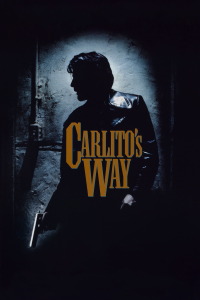
Review of Carlito's Way (1993) by Quentin T — 27 Nov 2009
Brian De Palma?s ?Carlito?s Way? is such a film with brilliant approach to situations and applied various filmmaking techniques that are way too overwhelming with beauty. It is as if scenes are presented with grace as the cameras dance the swing, occasionally get rested then go back to business after every while. The good thing is, it does not annoy; unlike other films with exaggerated camera works that are soon bound to enrage the audience with dizziness. The Hitchcock-like eminence of Brian De Palma?s filmmaking is evident in this film. The cinematography, camera shots, and the scoring are somewhat resembling some of the Alfred Hitchcock classics such as, ?The 39 Steps?, ?North by Northwest?, ?Rear Window?, and ?The Man Who Knew Too Much?. There are some photographs taken which will remind you of some 50?s classics like Gene Kelly?s ?Singin? in the Rain?. The chase is like some of Humphrey Bogart?s gangster films including ?The Maltese Falcon? and likewise Brian De Palma?s ?The Untouchables?.
Two Brian De Palma films that clearly stood out in ?Carlito?s Way? that made him well known for this genre of action thriller and suspense: ?Scarface? and ?The Untouchables?. In Scarface, the main hero Tony Montana (Al Pacino) is a gangster with astounding charisma and superior amount of guts to face his own evil self, and be the man he dreams of becoming. Tony Montana has lived the life he wishes but he soon finds himself trapped in his own mundane fantasies and evolves into a self-destructive demon of his dreams. In ?The Untouchables? De Palma has exhibited his seemingly natural technique to make people feel what the film suggests them to feel. In a simpler text, it employs earnest drama, action, thriller, etc. Both Scarface and Untouchables are meaningful for me is a sense of honest filmmaking with techniques I so admire and appreciate. ?Carlito?s Way? has established to me ?Brian De Palma?s wide vision and clear mind about the right choices like what he employed in his other films I also admire like ?Carrie?, ?Body Double?, ?Femme Fatale?, and occasionally, ?Mission: Impossible?, and so forth.
?Carlito?s Way? is a film that makes sense with simple timing techniques that enhances the audience?s intuition by participating in its plot-envisioning process. You will first need to know Carlito Brigante (Al Pacino) a little bit more and then realize what his life will to become. It is as if you know, but then the other characters act as additional variables to extract more from the plot and later deliver Carlito to the next unexpected level. The plot climbs up to its climax and later you know that you?re getting hooked. Added to the beauty of the plot are the actors that look just as the way you see their personas. Dave Kleinfeld (Sean Penn) is Carlito?s lawyer and at the same time, his best friend. He somewhat has this ?superiority complex? and thinks that he is the best and no one can defeat him even the bigger guys who usually carry guns in their pockets. At first, we recognize him as a studiously looking lawyer who has won several past cases. But the demon inside him makes him one of the vilest and most hated characters in this film. I compare him to Tom (Joe Pesci) in ?GoodFellas? whose ferocious evil destroys the very mainframe of his psychology and that soon engages him in a series of crimes and unlawful acts. He is even more comparable to Fredo Corleone in ?The Godfather? and ?The Godfather Part II?. This is because he stood out as a distrustful friend and brother to Carlito.
?Carlito?s Way? tells a story of an ex-convict and tycoon and his struggle in choosing the right path and making the best out of himself. But as opportunities and temptations emerge that he does not want to get involved with, he chooses to do things in his own little ways, as the title suggests. The factors that Carlito is molded into what he has become are his own self and his environment. Carlito is a struggler, finding his true goodness, but he is trapped inside a world that he himself made with his friends that constitute the beast in him.
In ?Scarface?, if the protagonist dies in the end of the film, in ?Carlito?s Way, we see him contemplating. The beginning is the end, and vice versa. Carlito narrates his story from the time he gets out of detainment up to the time he lies in the hospital bed. It is as if he tells how frustrating his past was and how he is willing to make changes in his life. As he stares at a poster on the hospital bed, he starts to mingle with sadness and kiss the pain with tears.
?Carlito?s Way? tells us a simple fact about life; that as long as we move away from temptation, it will occasionally follow us, especially in the hardest of situations. In there, we have a choice: to move away from it totally, or engage into it.
Stanley Kubrick?s 1971 ?A Clockwork Orange? shows how mean a person could become by exploiting the evil in him, like what happened to Kleinfeld in this film.
The main character in Werner Herzog?s 1977 ?Stroszek? is comparable to Al Pacino?s character in ?Carlito?s Way?. They both are ex-detainees and requested to keep away from doing bad things outside jail. But they are both victims of their own stubbornness and guilty pleasures.
The movie employs De Palma signature filmmaking techniques like the 360-degree camera panning for exciting parts like the dance scene in his 1976 ?Carrie?. The only part I did not like in this film was the ending. The part where Pachanka tells Carlito about his betrayal is such a wrong and corny move, since it is implied apparently that he was about to. But the part when Carlito lies alone in his hospital bed, contemplating, then suddenly the scoring plays, is such a powerful scene and an ending as well, as we feel his despair to bring back time, and do the things he must have done. It is not better than ?Scarface?, but quite interesting, at least.
This review of Carlito's Way (1993) was written by Quentin T on 27 Nov 2009.
Carlito's Way has generally received very positive reviews.
Was this review helpful?