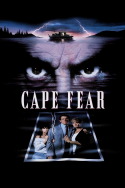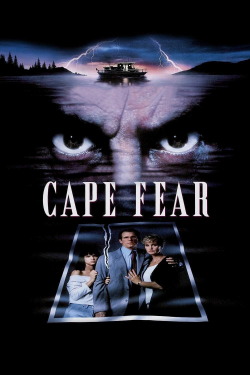
Review of Cape Fear (1991) by Moviemastereddy — 03 Apr 2016
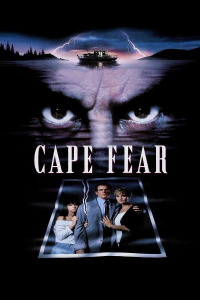
Martin Scorsese's "Cape Fear" is a work of rippling cinematic muscle. It's a brutal, demonic film with a grip like a vise; it grabs you early, its fingers around your throat, and never lets go. No one can give evil a more voluptuous surface than Scorsese; he's a dread master, and with "Cape Fear" -- his remake of the 1962 thriller with Gregory Peck and Robert Mitchum -- he's delivered a ravishing thesis on the anatomy of terror. If the director has set out to horrify us, then he's succeeded, and made us laugh at ourselves for being so spooked. "Cape Fear" scares you, all right, and more -- it makes your liver blanch.
What's puzzling about "Cape Fear," though, is why, at this stage of his career, Scorsese would set his sights so low. It's apparent by now that Scorsese can do just about anything he wants with a movie camera. His command of the medium goes far beyond technical brilliance; "GoodFellas" proved that and "Cape Fear" reconfirms it. He's got a blood instinct for hyperbolic moviemaking, so much so that the camera seems almost an extention of his own nervous system. His images hit the screen like firebombs, and the conflagration is enthralling, irresistible.
But "Cape Fear" is far from Scorsese at his best; in fact, it's our mostinteresting filmmaker's least interesting work. It's a slasher film, basically -- Scorsese's "Nightmare on Main Street" -- and to make it work the filmmaker misuses his gifts. What's he's done here is within the reach of a hundred other directors, none of whom is in his league. He's made the ultimate drive-in movie; a feat, perhaps, but disappointing nonetheless.
The movie premise is as straightforward as it is tough. Sam Bowden (Nick Nolte) is an attorney in a small Southern town, who 14 years ago unsuccessfully defended a brutal maniac named Max Cady (Robert De Niro) on a rape charge that, after being reduced to battery, sent him to prison. At the time of his trial, Cady was illiterate, but during his imprisonment he has become a bookworm, reading literature, philosophy and, in particular, law. All the while, Cady has dreamed of taking his revenge against Bowden, whose shoddy defense, he believes, is the reason he's lost his wife, his child and a big chunk of his life. And so when Cady is finally released, he makes a beeline for Bowden's peaceful home town, looking for a little payback.
The first sight of Cady doing push-ups in his jail cell is chilling. Sleekly sculpted and covered with apocalyptic tattoos, his body has the coiled malice of razor wire. Cady is a predator -- you can see that just from his smooth, loping gait -- and in the first part of the film, Scorsese focuses on his efforts to set up his prey. His main targets are Bowden's wife, Leigh (Jessica Lange), and his 15-year-old daughter, Danielle (Juliette Lewis); he stalks them like a panther, slowly and methodically moving in for the kill.
De Niro throws himself into the part of Cady with unmistakable relish; playing this madman seems to have energized him and opened up the dark channels of his talent. As Scorsese and his screenwriter, Wesley Strick, have created him, Cady isn't merely a psychopath, he's a Nietzschean superman, the cruel, killing hand of justice meting out a stern, remorseless form of punishment. Nobody is more frightening in these roles than De Niro, particularly when he's as fully committed as he is here. Every movement, every narrowing of his eyes, is a threat. Pulling his face into obscene, leering grins, he gives Cady a kind of goofy suavity, especially in the long, mesmerizingly languid scene in which he sweet-talks Danielle into his confidence. At times, the characterization verges on the comic -- it's a tremendously entertaining performance -- but it's comedy mixed with cutting quality of horror. You may laugh, but it's laughter with no release -- tense, scary laughter.
Still, you can't help but feel that both De Niro and his director have gone deeper into the same territory before, and that, in earlier films, the violence has had sturdier psychological roots. In remaking the effective but minor 1962 thriller, the filmmakers have improved on the original, but the original is still there, at least in skeletal form, and they haven't managed to transcend its limitations.
Nolte and Lange suffer most from the script's lack of depth; they're both strong, confident, exciting actors, but their characters here don't allow them to express anywhere near the full range of their talents.
Even here, it's impossible to be indifferent to Scorsese's work; he's a virtuoso, and for some filmmakers this movie would stand as a pinnacle work. But masters must answer to a higher standard, and, as dazzling as it is, "Cape Fear" simply doesn't measure up.
This review of Cape Fear (1991) was written by Moviemastereddy on 03 Apr 2016.
Cape Fear has generally received very positive reviews.
Was this review helpful?