Review of Calvary (2014) by Clarisesamuels — 08 Mar 2015
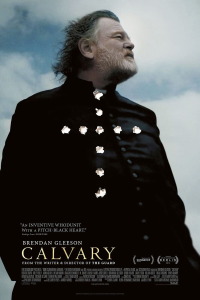
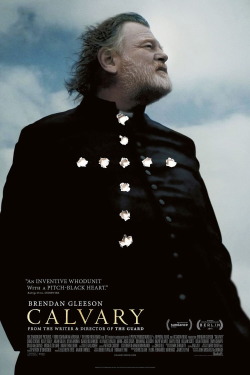
Brendan Gleeson’s portrayal of Father James, the tormented priest, is what saves this film from being a confusing morass of conflicting philosophies. Father James, a priest in a small countryside parish in Ireland, is haunted, lonely, and struggling with a number of demons. He still mourns his late wife, whose death drove him to become a priest; he has a disaffected relationship with his adult daughter (Kelly Reilly) who visits him after having recently attempted suicide; and he is a borderline alcoholic. His most intimate relationship is with Bruno, his dog.
The film starts out with Father James in the confession box. A parishioner, whom Father James recognizes by voice, confesses to him a long childhood history of being sexually abused by a priest, who is now deceased. The abuse went on for several years, involving a number of children, and caused a scandal that had been reported in the news long ago. The parishioner has a bizarre plan to rectify the injustice that he suffered—he wants to kill a priest, not an abusive priest, but a good priest like Father James, and he makes a date to meet him on the beach in a week.
Father James does not overreact, to say the least. He discusses the case with a superior, who tells him to report it to the police, but he is reluctant. He says he knows who the parishioner is, but he does not want to take impulsive action. During the week that transpires, which is marked day by day on the screen, Father James gives evidence of being deeply depressed, perhaps suicidal. In fact, the entire film is about death and suicide. The daughter visits him after a suicide attempt. Then Father James has to visit a prisoner who committed a grisly murder; the prisoner requests the death sentence even though there is no death sentence in Ireland. An elderly novelist who lives alone asks Father James to get him a gun, preferably a Walther PPK, so that when the time comes, he can kill himself rather than succumb to the frailties of dementia. Father James himself is suspiciously casual about the death threat he experienced in the confession box.
During the week, the priest has arguments and one fist fight with other villagers. He drinks himself silly. He tells off a lot of people. A rich villager offers him a dubious financial scheme, and insanely ends up urinating on a classic masterpiece that he owns. The only point taken is that the millionaire is mentally ill. Father James goes to the police inspector to talk, but the police inspector is distracted by his young, gay lover with the thick New York City accent, who is so hyperactive that he clearly is suffering from mental problems as well. A young wife in the village is promiscuous and currently cheating on her husband with an African car mechanic. She doesn’t check in as being completely normal either.
The most depressing part of the job is administering last rites, which Father James says is never easy, although with the aged, “it’s not any easier but it’s more understandable.” At the hospital, he is called in to give last rites to an accident victim. The Emerg doctor (Aidan Gillen) is smoking outside the building; he is jaded, callous, and militantly atheistic. He tells the priest, “I know the atheistic doctor is a cliché.” In short, there’s not one pollyanna to be found in the entire village. And during that troublesome week, the priest’s church is burned down by an arsonist, and someone viciously kills Bruno, presumably the same villager who wants to kill the priest on Sunday. In one last phone call to his daughter, Father James declares what he says is the hardest part of humanity—forgiveness.
This film isn’t about faith, more like using faith to escape reality, and even then, faith is not very effective. Father James only becomes a priest to escape the pain of widowhood, and he continues to drink himself into oblivion. And he never officially reports the death threat delivered in the confession box, for apparently, it’s a sin for a priest to commit suicide, but it’s not a sin if someone volunteers their services and does the dirty work for him. In the end, there’s no redemption for the believer or the atheist, just a glimmer of hope for those who can forgive.
This review of Calvary (2014) was written by Clarisesamuels on 08 Mar 2015.
Calvary has generally received very positive reviews.
Was this review helpful?