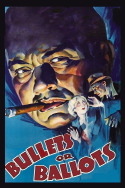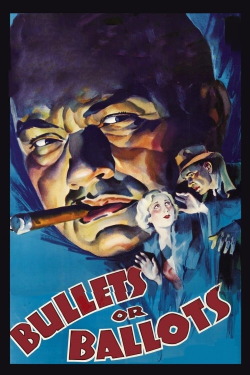
Review of Bullets or Ballots (1936) by Bill T — 13 Aug 2012
Crime Can't Pay Onscreen Even When It Still Was in Life.
This film was made as the Code was really starting to be a Serious Thing in Hollywood. Oh, it had existed for years, of course, but that didn't mean anyone was paying any attention to it. However, right about 1936, it was starting to become clear that there was a choice between self-policing and censorship, and it's hard to blame the studios for making the choice to self-police. Oh, I think there are a few things which might have been easier for the industry if they had been legally policed. However, at this point, the Supreme Court had ruled that movies were a business, not an art. They weren't covered by the First Amendment. Film censorship was Constitutional. And one of the things which drove the march toward it was the films of the '30s which glorified the gangsters. Crime was not allowed to pay. Even if that was ludicrous, and even if the people characters were based on were still alive and doing well.
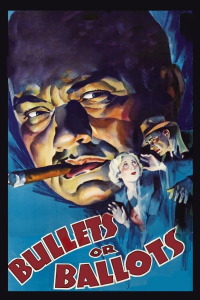
Johnny Blake (Edward G. Robinson) is a New York City cop. New York has a Crusading Police Commissioner, Dan McLaren (Joe King), and "Mac" fires Johnny very publicly, declaring that it's part of his campaign to clean up New York. Johnny has something of a relationship with Lee Morgan (Joan Blondell), who is a pioneer in the field of numbers running. He is also friends with Al Kruger (Barton MacLane), who gets him a job in organized crime. One of Al's boys, "Bugs" Fenner (Humphrey Bogart), suspects that Johnny is still a cop, because once a cop, always a cop. And he's right, of course. Johnny is working for Mac to bring down the mob. One of the problems is that only Mac knows who really runs the outfit, and Johnny has to gain his trust enough to find out who these people are. He offers up the numbers racket as the way to create himself an in, thinking they'll still let Lee run some aspect of it. But he doesn't know how things really work, I guess.
It's hardly surprising that the movie glosses over the black history of numbers. About the only black character in the movie is Nellie LaFleur (Louise Beavers), who works for Lee. At the beginning of the movie, the numbers racket is only run in Harlem and other neighbourhoods that audiences of the time would have known were people with blacks and immigrants. However, Lee is completely in charge by then, and Johnny takes it to the white male criminals. From then on, while it's still played by ethnic people, it's the WASP-y Hollywood mobsters who are in charge. Yes, okay, Edward G. Robinson was born Emmanuel Goldenberg. Fair enough. But he isn't playing a Jewish character here. His Jewish ancestry does not exist where the character is concerned; he is as white as Bogey, who was born upper middle class. Still, the audience this movie had in 1936 would have known that there were people whose stories were not making it into the movie; it's the cultural legacy we've lost because no one bothered writing it down.
The plot of this movie is frankly a bit confused. I wasn't sure what was happening most of the time, to the point that I wasn't entirely sure myself if Johnny Blake was still working with the cops or not. At least, not at first. It's true that undercover cops have a certain amount of leeway when it comes to committing crimes. They have to, because they have to commit those crimes in order to avoid blowing their cover. Fine. However, I'm not sure they're allowed to institute a whole new racket which covers most of New York. We have to have the ending we do, because it is the only way we can prevent the inevitable trial sequence which would logically have to follow the events of the movie. Certainly Johnny has to pay at least a little, because the Code is very clear on the fact that Crime Does Not Pay. Even, I suppose, when one is committing said crimes at the behest of the police commissioner.
The gangster movies of the '30s are in many ways similar to the blaxploitation of the '70s. Both were intended to play to an audience that mainstream movies weren't, necessarily--gangster movies appealed much more to immigrant audiences than the types of people who were, let's face it, the kind of people arguing that movies needed censorship. Oh, yes, blaxploitation movies are much more likely to star cops or private detectives and be about bringing down criminals. However, in many ways, these are just different ways of looking at the same problems. After all, the heroes of blaxploitation have come up from the same dirty streets as the criminals of the gangster movies. Johnny Blake and Al Kruger might, for all I was able to work out, have grown up in the same tenement. Certainly it wouldn't have been the first time something like that had happened in a gangster movie. Both kinds of movies were looking at very similar conditions in the world, though I think most film scholars have missed that. I, of course, am not most film scholars.
This review of Bullets or Ballots (1936) was written by Bill T on 13 Aug 2012.
Bullets or Ballots has generally received positive reviews.
Was this review helpful?