Review of Bride of Frankenstein (1935) by Devon B — 09 Apr 2013
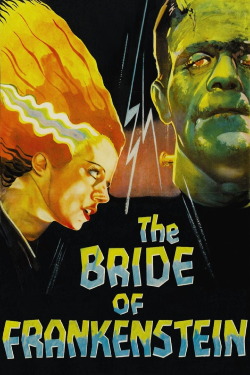
Even though 1931's "Frankenstein" was neatly wrapped up at the end, killing off the doctor and his monster, Universal intended to make a sequel to the monsterously successful film (Universal's policy was to use the same crew for the next film, which is why production was delayed four years, waiting for the director to become available again). Director James Whale wasn't crazy about making a sequel, and with "Bride of Frankenstein", he chose to have the monster speak (something Karloff was set against). The film begins with Mary Shelley and Lord Byron discussing the "complete" story of Frankenstein, the one never heard before. Of course the Doctor and the monster survived the fire at the wind mill, and as the doctor rested and recouped, the monster continued to reek havok on the villagers, exacting revenge upon them. That is, until he meets an old blind hermit who takes him in, and teaches him to speak. Doctor Frankenstein, meanwhile, is visited by a Doctor Pretorius, a scientist who, like himself, is in the business of creating life. But whereas Frankenstein does it by piecing together old bodies, Pretorius creates life from scratch (the flaw being that they're little miniature people). Pretorius wants to combine his work with Frankenstein's so that they might create a race of manmade people, and proposes that they work together to create a mate for the creature.
The film is a contrivance to be sure, but the uncomfortable creepiness of the monster is still there. In Mary Shelley's book, Frankenstein's monster was literate, capable of thought and feeling but evil because it had been created not by God, but by man and therefore was without a soul. In the film version of Frankenstein, the Creature is a failure of science, an aberration of nature, a sub-human. It's horrific by nature of it's existence. We may feel pity for it, but we cannot suffer it to live. "We belong dead!" screams the monster in it's horror, it's horror of self-awareness. Every fiber of it's being screams out for death, and yet it exists in spite of mother nature and God himself. Even the brief respite bought from friendship and food and wine can't satisfy. For the creature, life is only pain. And yet, it clings to it in spite of itself. It's one of the great mysteries of the monster, of "Frankenstein", and life in general. For some, "life is pain", for the rest, we can only shield ourselves from it's inevitable conclusion.
This review of Bride of Frankenstein (1935) was written by Devon B on 09 Apr 2013.
Bride of Frankenstein has generally received very positive reviews.
Was this review helpful?