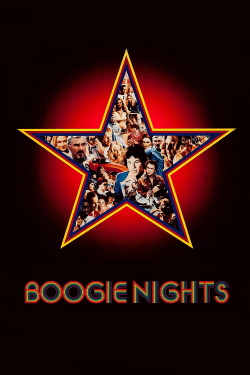
Review of Boogie Nights (1997) by Luc L — 12 Nov 2010
If writer/director P.T. Anderson began his filmmaking career on an ambitious note with "Hard Eight," then his second major film "Boogie Nights" takes that ambition and raises it to the nth degree. The film's style, structure, and scale tower over "Hard Eight," and while the characters may not be quite as complex, they are every bit as interesting; their odyssey through the 1970's and 1980's porn industry is something to behold.
The opening scene features one out of three very famous shots in the movie: a three minute tracking-shot that closely resembles and was inspired by a similar shot in Martin Scorsese's "Goodfellas." With this sequence, Anderson dives in head first, briskly introducing us to the huge ensemble of vibrant, diverse characters that will be flowing in and out of the film. As the camera swoops in, it follows Maurice (Luis Guzman) into Hot Traxx, the hot spot nightclub that he owns, where all of his fellow porn industry comrades gather to disco and party. The song that Anderson uses during this opening, "The Best of My Love" by The Emotions, also mimics Scorsese's song choice in Goodfellas, "And Then He Kissed Me" by The Crystals.
This entire film emulates Scorsese's style, and has drawn much criticism because of it. What is evident is that Anderson is paying thankful homage to the brilliant innovative style that Scorsese envisioned, while also taking broad strokes to shape it into his own fascinating vision. It is not a rip off, but rather a show of respect and admiration that Anderson employs to keep the audience engaged in his story and in his characters.
Eddie Adams (Mark Whalberg) is a suburban kid working as a busboy at Hot Traxx. He believes that everyone has one special thing, and that working at the club will get him discovered, and that he will be a "big bright shining star". Jack Horner (Burt Reynolds), a veteran adult film director, discovers Eddie, and so begins his rise to the top of the porn industry, and his pride-driven fall to the gutter where he realizes what is most important in life: family.
Amber Waves (Julianne Moore), Reed Rothchild (John C. Reilly), Buck Swope (Don Cheadle), Rollergirl (Heather Graham), Little Bill (William H. Macy), and Scotty J. (Phillip Seymour Hoffman) make up the cast and crew of the production family, with Jack Horner as the director and Eddie Adams-whose screen name becomes Dirk Diggler- as the star.
Anderson manages to capture something that is customarily seen as deviant in an astonishingly warm and matter-of-fact way. When the director yells action, it's work time. Anderson shows us porn as a business, and in that respect, he humanizes it in a way never quite seen before. The casual way by which he creates an intimate relationship between the audience and the characters is influenced heavily by the techniques that he employs with Director of Photography Robert Elswit, namely, the tracking shot. This shot creates the illusion that we are casually walking around at parties with the characters, and closely observing simple conversations, getting to know and like them better.
There are four wonderful tracking shots in Boogie Nights, which further drive the film's style into major Scorsese territory. The first, already mentioned, is the opening shot following Maurice through the nightclub. The second is at Jack's pool party, in which Eddie arrives after being kicked out of his home, and is introduced to his new family. This proves to be far more complex a shot than any other in the movie, as it follows a girl into a swimming pool just before cutting after over two and a half minutes. This sequence was inspired by a similar one in a 1964 film directed by Mikhail Kalatozov called "I Am Cuba".
The other two shots are similar; one is over three minutes, and follows asst. director Little Bill (William H. Macy) into a New Years party, pauses as he finds his unfaithful wife cheating on him (again,) and then follows him out to his car where he grabs a gun from his glove box. The shot continues, following him back into the house where he commits a murder-suicide. The other is at the very end of the film, and follows Jack as he walks through his home to composer Michael Penn's melancholy circus music, further emphasizing the atmosphere that Anderson creates with his camera. These are both stupendous shots, and they flow very well in the film without being the least bit distracting or destructive to its integrity.
Like in Hard Eight, these characters feel authentic, each one possessing some form pretense that he/she shies away from the business and from the party. Amber acts as the warm, loving, cheerful mother of the family, while in reality she is severely estranged from her ex-husband, who refuses her custody of her son because of her sex and drug filled lifestyle.
Rollergirl tries to be a carefree party-girl, while she is really a kid who has yet to graduate high school, and who is harassed by boys and cannot face the classroom environment. Anderson gives us a very brief, but telling scene where she sits idly in class gazing out the window, before turning to see a male classmate making suggestive gestures toward her. She storms out of class, and given that her real family is never even mentioned, it seems that she is simply another stray like Eddie who has either left home or been kicked out; she has found a new family that accepts her.
It is extraordinary that Anderson is able to balance so many characters in one film and, with the help of tremendous actors, is able to give each of them an interesting story and personality. He molds alienated characters into his films, and themes involving how these "outsiders" manage to find their ways in life. These themes have continued throughout all of his films. He is a director to be reckoned with in this generation, and as he continues to explore these themes and write and direct compelling films like "Boogie Nights" and "Magnolia," his relevance in the world of cinema will continue to prevail.
This review of Boogie Nights (1997) was written by Luc L on 12 Nov 2010.
Boogie Nights has generally received positive reviews.
Was this review helpful?