Review of Bonnie and Clyde (1967) by Chris E — 06 Apr 2010
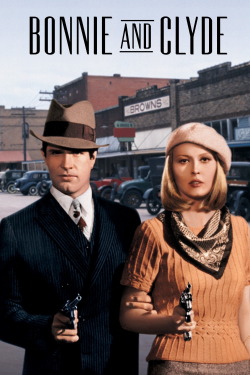
Forget "Natural Born Killers", forget "Wild At Heart", forget "True Romance"; if you want a truly enticing tale about murderous lovers, go rent the delightfully violent and sickeningly sweet "Bonnie and Clyde." Arther Penn's story of the 1930's antiheroes on the run may not be the accurate portrayal of the infamous criminals, but he certainly made the couple pretty damn likable. Back in 1967, the landmark achievement in cinema was buried at the Oscars by movies like "The Graduate", "Guess Who's Coming To Dinner", and "Point Blank". Though this is no doubt that Penn's glorified portrayal of violence and sex contributed to the lukewarm reception (it didn't have the sense of relatability that made "The Graduate", which displayed sex in a sordid light, so popular), now "Bonnie and Clyde" has been ravished by several critics as a masterpiece, a tour-de-grace of murder and good-old southern hospitality (or a lack thereof.
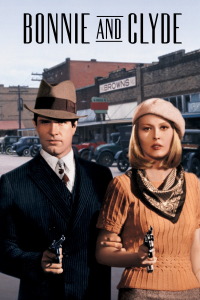
The plot is both famous and misinformed (as I said before, Mr. Penn didn't direct the true story of the cross-country killers): while on a bank-robbing spree, career criminal Clyde Barrow (Warren Beatty) is aquanted with bored Southern girl Bonnie Parker (Faye Dunaway, in quite possibly her greatest performance, right next to "Chinatown"). Bonnie assists in Clyde's next stick-up, and the couple quickly fall in love. As the they travel across the vast state of Texas, they are accompinied by lepraucan-ish C.W. Moss (Michael J. Pollard), a gas-station attendent who is invited along as a getaway-driver, but after causing Clyde to kill the clerk at a bank they just raided, the couple now must escape police officers with permission o kill. Clyde's trouble-making brother Buck (Gene Hackman, in an early role) and his wife Blanche (Estelle Pearsons) are also forced into fleeing the law after harboring the couple. This motley crew of criminals (some unwilling) spend the remainder of the film traveling the country and toying with the justice system. Oh, and Gene Wilder shows up halfway through the picture. Unfortunatly, he doesn't sing any light-hearted ballads that capture the imagination of childhood. But it would be nice if he did.
Warren Beatty is different from any other actor of his generation or of today; this is because we don't see that much of him. While most actors and actresses overload themselves with roles, to the point where even the best performers seem trivial. But Beatty only accepted a role every few years; since they're are only a few films (in relation to other actors of the era) that Beatty was in, he remains fresh and mysterious, something only players like Marlon Brando and Clint Eastwood have achieved. Faye Dunaway is remarkable as well, not in the same respect as Beatty, but because her roles are so diverse, and that allows her to remain enjoyable, no matter how much we see of her. The leads are not the only actors to enjoy; "Bonnie and Clyde" also has a spectacular support cast. The then-unknown Pollard plays his part perfectly, capturing the role with an oddly loud, yet partly subtle presence. And who can hate on Gene Hackman? If you can ignore "Behind Enemy Lines", there has been a film with Gene Hackman that I couldn't at least mildly enjoy. Gene Wilder is a bit less... crazy... then some of his other pictures, but he still brings a trademark zaniness to the role.
Infamous for it's stylized violence, "Bonnie and Clyde" broke many sacred Hollywood taboos. While heavy amounts of violence and gore may be a commonplace in films today, in the trippy 60's, such graphical scenes were strictly regulated. Everyone who saw the film in '67 recalls Clyde shooting the bank clerk in the head, Blanche Barrow taking a bullet to the eye, and the legendary end scene in which the couple reach their untimely end in their bullet-ridden vehicle. Ever since then, hardcore violence has become the norm in Hollywood. Whether that's for better or worse depends on your own personal preference. And phrases like "getting in your pants" aren't that sacndolous today, everyone was shocked by it in the 60's.
The narrative is mostly coherent, but there are a few holes in the plot; for example, there is no explanation for where the gang is getting weapons and clothing. I know this must tedious, considering I've already said it twice, but the story is not congruent to the actual odessey of Bonnie and Clyde. Though if it was, the film would incredibly different.
Final Overview:
If you can overlook the plot deficiencies and historical inaccuracies, you will find a tremendously entertaining and influencel film, carried by terrific performances from all players involved.
Rating: 8 cops hiding in the bushes out of 10.
This review of Bonnie and Clyde (1967) was written by Chris E on 06 Apr 2010.
Bonnie and Clyde has generally received very positive reviews.
Was this review helpful?