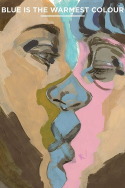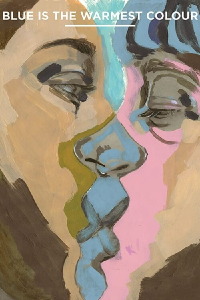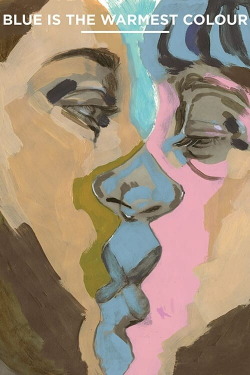
Review of Blue Is the Warmest Color (2013) by Eero V — 29 Dec 2013
There's something oddly similar between Blue is the Warmest Color and last year's Zero Dark Thirty. Both have been embraced by critics and tipped for major awards, but at the same time have created massive controversy. Blue is the Warmest Color won this year's Palme d'Or at Cannes Film Festival, and since then has raised plenty of debate due to its graphic sex scenes and the uncomfortable circumstances the actors and the other staff had to work under. I dismiss this by saying: let's just wait for Lars Von Trier's new film. I suppose so that film is going to create even more dispute. In the meantime, let's pay attention to one of the most interesting films if the year.
The film tells a story about Adèle, a 16-year old high school student who wishes to become a teacher. She struggles to find her sexual identity, since even sex with the cutest boy of the school leaves her cold. One day she coincidentally walks into a girl named Emma on the street. Adèle cannot forget her face, and soon befriends her when meeting her at a gay bar. They start developing a romantic relationship, and Adèle feels happier than ever before. But in due time she gets to experience the downhills of life and love.
Blue is the Warmest Color is one of those films that easily get praise for such things as "raw emotionality" and "uncompromising honesty". Films that endeavor such things often turn out to be real masterpieces (The Wrestler, Amour) or pompous, sentimental and self-indulgent melodramas (Crossing Over, The Place Beyond the Pines). In honor of Blue is the Warmest Color, it has to be said that director Abdellatif Kechiche has achieved his goal. The film feels very raw and real, and the feelings of the characters sincere. The sentimentality is kept at minimum, and the continuous use of close-up shots creates a very intimate atmosphere.
Another merit in Blue is the Warmest Color is its ambition. I did go into the theater thinking that this might be just like Show Me Love (another film about lesbian love), only with a different language and a longer running time. But as much as the film is a story about passionate love, it is as much a story about maturation and growing up. At the beginning of the film Adèle is zestful, but still looking for her path; she is hesitant and nowhere near as single-minded and bold as Emma. But the longer she spends time with her, the more she learns about life and love, but also making mistakes. The direct translation of the film's French title is "The Life of Adèle", which is somewhat ironic, since at the very end of the film Adèle's life is still at very early stages. She still has plenty of things to see and learn, and a lot of disappointments and up- and downhills ahead.
Kechiche tells the story thoroughly. The 3-hour film builds from long dialogue-driven scenes and artless cinematography. The story is told in two parts; in the first one, Adèle is still on high school, while in the second one she is starting her career as a teacher and has lived with Emma for some time. Both parts are equally impressive, but to me the second one was more affecting. There the relationship of Adèle and Emma is on the rocks, and their confrontations are heartbreaking to watch.
The two lead actresses are stunning. Adèle Exarchopoulos gives a performance where the line between the character and the actress is blurred, inhabiting the character of Adèle completely. She is in every scene, in fact in almost every image, and handles the massive task magnificently. Léa Seydoux, who is slightly more well-known as an actress, has less screen time but still makes a grand impression.
A couple flaws still have to be remarked. As I said, the film runs for three hours. It is elaborate, well paced and richly detailed, but do you really need 180 minutes to tell this story? I think not. I wasn't tempted to check the time, but some sequences go on for too long. There are many scenes of Adèle crying, and many of them just turn to excessive sniveling. And I wouldn't mind if those much talked about sex scenes were shorter, no matter how revealing, honest and audacious they may be (the longest one was maybe seven minutes).
There is also a problem with the close-ups. They make the film intimate and palpable, but at times they get strenuous, mainly in the scenes of people eating. I don't know many more irritating things than people eating with their mouth open, and Adèle does it all the time. It feels odd to complain about something this insignificant; it's a film, not real life. But seriously, at times it was nerve-racking.
Nevertheless, Blue is the Warmest Color is a very impressive piece of work with two brilliant lead performances, strong verisimilitude and emotional complexity. It is by no means an easy film to sit through, but in the end it is instructive, beautiful and richly rewarding. Despite its overlong length, it doesn't feel like a tribulation. It isn't as monumental as Amour, for instance, which won the Palme d'Or last year. But both films are wonderful examples of how from everyday situations and conversations you can make some really powerful cinema. Is it something really unique and groundbreaking? Maybe not, but you have to look past the surface to see its subtleties.
This review of Blue Is the Warmest Color (2013) was written by Eero V on 29 Dec 2013.
Blue Is the Warmest Color has generally received very positive reviews.
Was this review helpful?