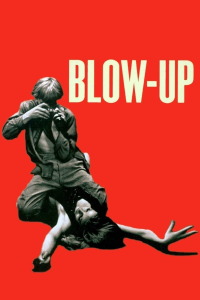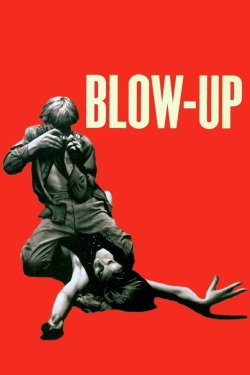
Review of Blow-Up (1966) by Blake P — 22 Sep 2014
In the opening scenes of "Blowup", we are transported into 1960s London, the London Diana Vreeland labeled as "the most swinging city of the world at the moment". With doll-like women that have the hair of Françoise Hardy, the body of Twiggy, and the mannerisms of Brigitte Bardot, it's a maze of mod lifestyles and cheerfully banal attitudes.
One such person living a mod lifestyle is Thomas (David Hemmings, in an iconic role), a young photographer with a flat any artist would dream of. When we're first introduced to Thomas, he is in the process of a photo shoot, his star being supermodel Verushcka von Lehndorff. The scene, covered in big hair, put-upon sexual tension, and poses that would only be appropriate for "Interview", is remarkable: it sets the stage for the rest of the film.
There are the kinds of masterpieces that hit you emotionally, like the latest Steven Spielberg project or the series finale of the greatest show on television; but then there are the kinds that Michelangelo Antonioni makes. "Blowup" is drenched in silence, enigma, danger, boredom, fashion, style - it's a complete work stacked to the top of impeccably shot scenes, scenes that don't always add up but leave an abiding impression on the viewer, not easily shaken off.
Following his photo shoot, Thomas takes a trip to the park, sees a fascinating couple, and being a photographer, lets out his inner paparazzi in the sake of art. The woman (Vanessa Redgrave), rattled by Thomas' nerve, confronts him; but even we can tell that there isn't something right about the situation.
Later on, she arrives at his flat, angry and demanding she have the footage. She does everything she can - even taking her top off at one point, in hopes of seductive manipulation - but she doesn't get her way. When developing the said pictures, Thomas is reminded of the woman's strange fury. And through detailed analysis and a series of blowups, he finds that it wasn't just he, the woman, and her boyfriend in the park: there was also a murderer and a victim.
We don't find out who the murderer or the victim is, by the way - if we did, "Blowup" wouldn't have that same overall feeling of emptiness it holds with such careful restraint. It contains an emptiness not like a hollow Andy Warhol film, but one that reflects a consistent tedium in life. Once Thomas finds that he has discovered a killing, there is a spark of sudden fervor.
In the best scene of the film, Thomas sets every picture of the park side by side, blowup to blowup, making the connection, and we can feel goosebumps creeping up our arms. The scene is edited with seamless energy: the camera pans back in forth between the photos, and finally, plays them in a slide show, with increasing tightness that is just as cloying to us as it is to Thomas.
But "Blowup" shouldn't be mistaken as a murder mystery, because, usually, murder mysteries tell us who was at fault, why it happened. The film is an exercise, a study of the mod culture. The discovery of the death feels like a dramatic event rather than mere plot device. It's like a rock, thrown into a river: at that moment, it creates a rippling effect, creating action everywhere in its wake, only to be covered up once again by the same rat race.
When Thomas actually stumbles upon the body at one point, we come to two conclusions: 1) this man was murdered, in an albeit bloodless way, or 2) he dropped dead, possibly of a heart attack. The latter would certainly explain Vanessa Redgrave's fretful panic. We never truly know. But like "Mulholland Dr." or "L'Avventura" or "La Dolce Vita", there doesn't need to be closure to make a great film. It's our aftertaste that matters, and "Blowup"'s is one of startling obsession.
This review of Blow-Up (1966) was written by Blake P on 22 Sep 2014.
Blow-Up has generally received very positive reviews.
Was this review helpful?