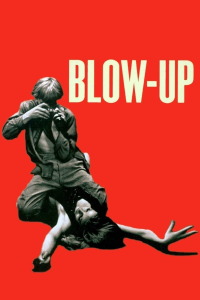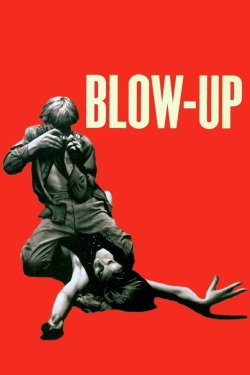
Review of Blow-Up (1966) by Ola G — 31 Oct 2015
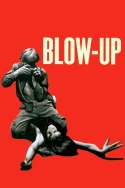
After spending the night at a doss house where he has taken pictures for a book of art photos, glamorous fashion photographer, Thomas (David Hemmings), is late for a photo shoot with famous model Veruschka at his studio, which in turn makes him late for a shoot with other models later in the morning. He grows bored and walks off, leaving the models and production staff in the lurch. As he leaves the studio, two teenage girls who are aspiring models (Jan Birkin and Gillian Hills) ask to speak with him, but the photographer drives off to look at an antiques shop. Wandering into Maryon Park, he takes photos of two lovers. The woman (Vanessa Redgrave) is furious at being photographed. The photographer then meets his agent for lunch, and notices a man following him and looking into his car. Back at his studio, Redgrave arrives asking for the film, but he deliberately hands her a different roll. She in turn writes down a false telephone number to give to him. His many enlargements of the black and white film are grainy but seem to show a dead body in the grass and a killer lurking in the trees with a gun. The fact that he may have photographed a murder didn´t occur to him until he studied and then blew up his negatives, uncovering details, blowing up smaller and smaller elements, and finally putting the puzzle together...
Bosley Crowther, film critic of The New York Times, called it a "fascinating picture, which has something real to say about the matter of personal involvement and emotional commitment in a jazzed-up, media-hooked-in world so cluttered with synthetic stimulations that natural feelings are overwhelmed". Crowther had reservations, describing the "usual Antonioni passages of seemingly endless wanderings" as "redundant and long"; nevertheless, he called Blowup a "stunning picture - beautifully built up with glowing images and color compositions that get us into the feelings of our man and into the characteristics of the mod world in which he dwells". Of the film's ending, Roger Ebert wrote in The Great Movies: "What remains is a hypnotic conjuring act, in which a character is awakened briefly from a deep sleep of bored alienation and then drifts away again. This is the arc of the film. Not 'Swinging London.' Not existential mystery. Not the parallels between what Hemmings does with his photos and what Antonioni does with Hemmings. But simply the observations that we are happy when we are doing what we do well, and unhappy seeking pleasure elsewhere. I imagine Antonioni was happy when he was making this film."Ebert also published a letter by actor Ronan O'Casey which claimed that the film's mysterious nature is the product of an "unfinished" production, and that scenes which would have "depict[ed] the planning of the murder and its aftermath -- scenes with Vanessa, Sarah Miles and Jeremy Glover, Vanessa's new young lover who plots with her to murder me -- were never shot because the film went seriously over budget." "Blow Up" is a frenetic, insinuating, paranoid and "what if" film, but yet it´s slow paced and energetic at the same time. I love how Antonioni has used the "Swinging London" (clothes, fashion, music, environments, people) and particularly the fashion scene to its full extent and that adds so many layers to the film. The anti-hero Thomas, a self obsessed, cruel and with a larger than life persona is played perfectly by Hemmings. His facial expressions and movements carries the whole film and with a young Vanessa Redgrave as his counterpart we see movie magic on the screen. The storyline is based on the idea that everyone perceives reality in their own way and ultimately see only what they want to see. We can be blind to reality in our own little bubble and that feels even more current today than it did in 1966. The end shows that what seems to not exist in reality can actually exist in your mind. What is true and what is not true? It´s in the eye, ears and mind of the beholder. Michelangelo Antonioni offered little in the way of insight into his intentions with the film, and was always clear that meaning wasn't meant to be spelled out. "By developing with enlargers...things emerge that we probably don't see with the naked eye....The photographer in Blow-Up, who is not a philosopher, wants to see things closer up. But it so happens that, by enlarging too far, the object itself decomposes and disappears. Hence there's a moment in which we grasp reality, but then the moment passes. This was in part the meaning of Blow-Up." Vanessa Redgrave offered her take on the film in her autobiography. "Blow-Up was about the unity and difference of essence and phenomena, the conflict between what is, objectively, and what is seen, heard, or grasped by the individual." "Blow Up" is a testament to the 60´s "Swinging London" and a truly engaging movie experience. Trivia: Michelangelo Antonioni's first choice for the role of Jane was the Swedish actress Evabritt Strandberg, after spotting her in Bo Widerberg's film Kärlek 65 (1965). She went to London to meet Antonioni. He approved of her, but the three MGM bosses present at the meeting didn't like her "big nose". The role went to Vanessa Redgrave.
This review of Blow-Up (1966) was written by Ola G on 31 Oct 2015.
Blow-Up has generally received very positive reviews.
Was this review helpful?