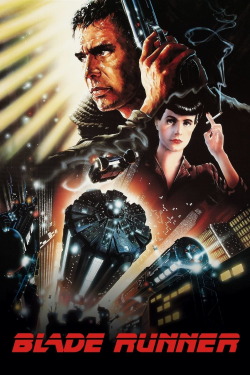
Review of Blade Runner (1982) by Jackson M — 15 Dec 2012
Each respected genre (when executed to its maximum potential), contains the power to represent a quintessential characteristics that is solely unique to its own capabilities. For instance, there is "Horror," a genre that has found a distinct resonance within its celluloid projection of the fragments and psychological state of the human mind. "Comedy" is quite possibly the most audacious of them all, containing the exclusive ability of satirizing and mocking societies idealized institutions while conversely containing the ability to put a smile on your face (cough, cough "Dr. Strangelove"). And to rattle one more out - the "War" genre, films that portray, like no other, the realism and fatalism between life and death. However, of all them genres (and the ones that I haven't mentioned), Sci-Fi contains the quintessential characteristic of being the most profound - subjective of course. I distinctly remember after finishing Kubrick's "2001," I was not simply stunned from its ambiguous and thematic brilliance, but rather left with an ever-lasting expansion of my imagination and illumination to the power that films can convey. Truly, there's only one of other Sci-fi that belongs in this category; and after my fifth viewing I am still stirred by Ridley Scott's masterpiece "Blade Runner." Each viewing gains a new level of appreciation for its layers: riddled with visual mastery, cryptic thematics, a philosophical of what constitutes to be human and what doesn't, religious symbolism and so many literate devices and references that if William Blake ever made a film, it would most likely contain the same feel as this.
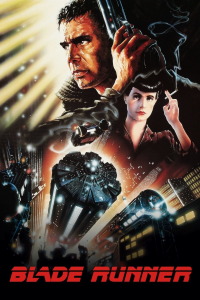
In similar vain as "Star Wars," "Blade Runner" begins with an opening scroll, detailing the plot and the political climate in a futuristic Los Angeles. Within the future, human cloning has become rampant; the clones are referred to as a"Replicates," and with the embedded irony of all humans greatest technological achievements, the Replicates have become a problem to humanity. As a result of these strains, individuals known as "Blade Runners," have been designated to deal with these specific problems. Through Scott's narrative, we only meet one, Rick Deckard (Ford); a man who initially seems to portray distinct hard-boiled masculine values, but is only essentially a psychological wreck. His mission: find and kill the four Replicates that have returned from earth to meet their maker.
As important as it was back then, and as important as it is today and most likely forever within its genre; visual presentation is an essential component to Sci-Fi's. "Blade Runner," - with the accompany of the "Final Cut" and its new print presented in 1080p on Blu ray - contains the most beautiful visual images ever to grace the silver-screen. The opening shot displays a Los Angeles that resembles a hell on earth; obviously developed within manufacturing, the factories flames burn against the back-drop of the dark sky as a ship slowly descends upon the Tyrell corporation - a passage is truly breathtaking. Continuing with this visual prowess, it's not just the grandeur moments that display a richly detailed landscape (which most Sci-fi rely on), but also the subtle ones. Whether you are watching the sweeping shots of the juggernaut Bill-boards, or simply the monochromes of black whites with the accompany of hazy, noirish smoke, or even the interior of Sebastian's (Sanderson) apartment; each individual frame contains the utmost appreciation of visual presentation. Additionally, likewise to Lang's "Metropolis" and Kubrick's "2001," Scott's landscapes have obvious metaphoric resonance; Lang used the the manufactured to display a form of social oppression and a Marxist perspective of social classes, while Scott's world is one of wondrous technical achievements, but paradoxically, suffers the distraught of urban decay. Likewise to Kubrick, Scott obviously believes in the notions of irony embedded within the advancements of technology: our greatest achievements can eventuate in our greatest downfalls.
Ultimately, the world that Scott has created pays homage to previous opus', while still containing a sense of authenticity in equal measure. On the subject of homages, Scott's universe is draped with Film-Noir references; ranging from the silhouette projection of bars from the curtains, evoking "Double Indemity," and Deckard's core characteristics are influenced from "The Big Sleep" Phillip Marlowe.
Surprisingly, after my first viewing of "Blade Runner," the film situated within the "Action" genre. A quick warning: if you haven't seen "Blade Runner," do not expect upon initial viewing a Sci-Fi with space-operish qualities, but rather an adventure handled with elegance and subtly, as there is action (which occurs rarely often), but is often treated within the most elegant process; evoking the fine lines between life and death.
However, the most rewarding aspect that separates this film from the archetype action Sci-Fi is its enigmatic characterization; a world riddled with contradictions, emotional wrecks, morally ambiguous, isolation, and the old whiskey for comfort. To begin with, there is obviously Deckard: a man - as previously stated - that initially seems to represent masculine values, however. As we continually dig deeper, his story and life is quite tragic. Seemingly lost his love, Deckard is an alcoholic, suffers a sense of isolation, and morals are riddled with contradictions. Ultimately, this tragic story against the back-drop of a world engulfed in urban decay all equalize in an atmosphere that conveys a melancholic feel for the future. Once again in the same vain as Kubrick, the Replicates are the characters that seem to contain genuine emotions (H.A.L would fit right in!), especially Rachael (Young). Initially, Rachael seems human like, but after various test and utilization, she is a Replicate with one unique quality: the containment of implanted memories. Rachael is most definitely the emotional beacon; a woman that has come to terms with her existence and the fact that she is simply an exploitation of human use. Ultimately, due to their past and hopefully futures, the relationship developed between Rachael and Deckard is a love story with tragic (and Shakespearean) qualities.
Within the 'antagonist' side of Replicates, Rutger Hauer's portrayal of Roy Batty is mesmerizing. The leader of the fallen Replicates, Batty is a 'man' that glows with provenance. A character that contains an abundance of knowledge, a wealth of intelligence and genuine emotion. Deckard and Hauer existence within the same spatial space lends to a continuous juxtaposition of humans and Replicates and Scott's central, philosophical theme: what constitutes to be human? Consider the climatic sequence: Deckard and Batty begin within Sebastian's apartment and culminates upon the roof-top and in the purifying rain. Exasperated, and about to come to the end of his life span, Batty speaks a Shakespearean soliloquy that deserves quotations:
"I've seen things you people wouldn't believe. Attack ships on fire off the shoulder of Orion. I watched C-beams glitter in the dark near the Tannhauser gate. All those moments will be lost in time... like tears in rain... Time to die." - Roy Batty.
Simultaneously poignant and melancholic, Batty's final words contain profound resonance. They suggest and make the audience question: what does it mean to be human? Obviously Batty is a Replicate, but his final soliloquy displays non-Replicate qualities, but rather that of a human who is fond of his ever-lasting memories with the accompany of genuine emotion. Furthermore, throughout the whole movie Batty fears the one entity that all humans fear: death. And who are we to judge his life-span? Within "The Final Cut," Scott even goes a step further and suggest that (Spoiler alert!!!) maybe even Deckard is a Replicate.
Likewise to its ending, "Blade Runner" is riddled with literature innuendos and devices. And once again, Batty's final passage contains literary resonance. Batty embodies various forms of symbolism and allegoric characteristics. Beginning with the former, Batty's terminating poignancy on the nature of Replicates subordinate position culminates with Batty releasing a white dove into the air; a moment that is symbolically suggesting the internal emotions and essential characteristics that constitute for human existence is also resonant with Replicates. Furthermore, 'Eyes' are a continuous symbolic motif. Suggested to provide the internal perspective of human emotion ( Just watch "The Passion of Joan of Arc"), or rather the gateway to the soul, Scott's emphasis on such a human organ was due to the fact that he believed that eyes were humans most important component. His comments obviously concur:
"I was also trying to say that the eye is really the most important organ in the human body. It's like a two-way mirror; the eye doesn't only see a lot, the eye gives away a lot. A glowing human retina seemed one way of stating that". - Ridley Scott.
A paradoxical gateway if you will. On a subjective viewpoint and the relations of Eyes to "Blade Runner" and its overall thematics, is that the Eyes are the central organ to obtaining memories. And, drawing of the introductions of the Tyrell corporation with the juxtaposition of the retina absorbing the granduer imagery - the message is clear: Eyes function as another counterpart that Replicates share with humans that are not eccentric traits but rather ones that are cohesive with human nature. Within relation to allegoric qualities, the fugitive replicates share many allusions to Christianity traits. Consider the various elements, the Replicates are robotic cyborgs that have fallen from another planet - a notion that contains resonance with the concepts of 'Fallen Angles,' because with all respect, the target characters are really the only ones that seem morally justified. Furthermore, through the final shoot-out, we see Batty poking a silver peg through his hand; an obvious suggestion that Batty serves as an allegory for Christ himself and his final sacrifice, which is Deckard.
As stated, with each annually viewing of "Blade Runner," a new level of appreciation continues in accumulation; continuously excited that each viewing will reveal another secret, whether it be within terms of cinematic qualities, thematically or its conflicted and tragic characters, it's a film that needs the utmost attention from its audience to appreciate its ever-lasting qualities. This is the sole reason why I consider Ridley Scott's early effort a masterpiece; a continuous jig-saw puzzle, and after each viewing I gain various pieces but never obtain the whole image from initially appearance - it's a film that deserves to be analyzed from every frame corner. "Blade Runner" is not only a film that contains the most beautiful Sci-fi presentation, memorable characters, thematics that are studied upon days ends with the accompany of riddled literature references; but a film that deserves the title of masterpiece and even one of the best films ever made. As Rita Kempley would state:
"Grand enough in scale to carry its many Biblical and mythological references, Blade Runner never feels heavy or pretentious -- only more and more engrossing with each viewing. It helps, too, that it works as pure entertainment.".
This review of Blade Runner (1982) was written by Jackson M on 15 Dec 2012.
Blade Runner has generally received very positive reviews.
Was this review helpful?