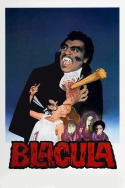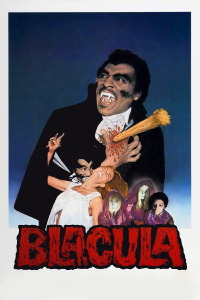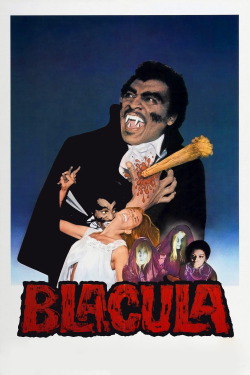
Review of Blacula (1972) by Edith N — 14 Feb 2010
Too Hilarious Not to Watch.
Some years ago, when Episode III came out, a friend online said that he and his (girlfriend? wife?) were insanely amused by the scene wherein Emperor Palpatine bestows a new Sith name on his young apprentice. For those who have blocked memories of the movie, or were just lucky enough not to see it at all, he looks very seriously at the screwed up young Skywalker, and he says, "I will call you Darth . . . Vader." This led my friend and his SO to speculate about the "Big Book of Darth Names," which Palpatine was presumably running through in his head during that pause. This then produced an enormous thread of names specifically ruled out in said book, including "Darth Fluffy Bunny Feet," "Darth Python," and others. You can probably find the thread with a quick Google search. At any rate, in the beginning of this movie, which is much more entertaining, Dracula (Charles Macaulay) gives the same sort of pause, even though the name he chooses is such an obvious one that I'm frankly astonished it took until 1972 for movie makers to think it up and cash in on it.
Mamuwalde (William Marshall) is, of course, an African prince. His people have sent him and his new bride, Luva (Vonetta McGee), to Europe to protest the slave trade, which apparently is at its worst in Transylvania, because that's the actual Count Dracula who transforms him into a vampire for no other purpose than to drive 93 minutes of plot. His bride is killed but not turned, because that enables him to go after the "mysteriously like her because she's played by the same actress" Tina. Tina is, I think, the sister of Michelle (Denise Nicholas), who is in a relationship with Dr. Gordon Phillips (Thalmus Rasulala), and I think Tina works for him at the morgue. Mamuwalde/Blacula is brought to Los Angeles and raised from the undead by a couple of camp-gay antiques dealers who have bought the whole of Castle Dracula's miraculously preserved furnishings. Mamuwalde then goes "terrorizing" a largely unmoved populace, driving what we will jokingly refer to as the plot.
This film fails in the way less thought out vampire fiction tends to, a way Terry Pratchett discusses in [i]Carpe Jugulum[/i], his treatment of the vampire mythos. Everyone these vampires kill (through blood loss; Luva is merely walled up alive) then becomes a vampire. This is impractical, as even the cops in this movie acknowledge. When Mamuwalde kills people he intends to just kill, he doesn't bite them or otherwise drain their blood. There's a scene late in the film where he just starts whaling on a cop with a pipe. It's hilarious, simply because, were there no fear that the cop would just later rise, it would be so much easier to kill him in a way a common serial killer wouldn't use. And, as Vlad de Magpyr explains in the abovementioned book, if everyone gets turned into a vampire, soon enough, what will the remaining vampires eat? Admittedly, it'll take a lot longer in Los Angeles, but how long was Dracula supposed to have been hanging around Transylvania?
Of course, there is no taking this movie seriously. It's a blaxploitation vampire movie. And so you must understand that this is a terrible movie. It gets a positive review here simply for the camp factor. It's hilarious. It may well even be trying to be. There are people at the end who get killed in much funnier ways than the poor beaten cop. The makeup is traditional low-rent horrible horror movie makeup. When Mamuwambe meets the Sun at the end of the movie (what, you were expecting him to live just because there's a sequel), the decay is simply hilarious. Gross, but hilarious. There's Elisha Cook, Jr., running around the morgue, and it rather feels as though his paycheck was the single highest thing in the budget. The police office must have been borrowed from another movie, as there's a big map of Long Island on the wall. The "hidden passages" of Castle Dracula seem made out of cardboard--they don't even seem able to afford the plywood of higher-budget low-budget movies.
Seriously, though, what did take the industry so long to come up with this movie? It can't be coming up with a plot; the makers here didn't bother, so why should anyone else have tried? I suspect that several decades' worth of that delay was the belief that you couldn't build a movie around black people. (Though they'd been doing just that for forty years at the time, so there it is.) Maybe it was that people didn't think you could build mass-appeal movies around black people, but you know, blaxploitation was never what you'd call mass-appeal anyway. If, decades earlier, people were coming up with "Dr. Acula," which is a little strained, what took so long into the blaxploitation era (while its height was in the mid-'70s, well after this movie was made, it got its start in the late '60s) for them to come up with such an obvious title? Somebody was falling down on the job, clearly.
This review of Blacula (1972) was written by Edith N on 14 Feb 2010.
Blacula has generally received mixed reviews.
Was this review helpful?