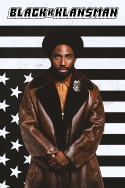
Review of BlacKkKlansman (2018) by Bertaut1 — 02 Sep 2018
Polemical, didactic, confrontational, angry, trenchant - a state-of-the-nation address.
BlacKkKlansman is a film with a lot on its mind. It opens with one of the most (in)famous scenes from Gone with the Wind (1939), before pivoting to a fictional precursor of Alex Jones lecturing the audience on the dangers of the "negroid", and later takes in everything from Kwame Ture to David Duke, before lambasting The Birth of a Nation (1915), criticising the tropes of classic Blaxploitation films, going into agonising detail regarding the 1916 lynching of Jesse Washington, sardonically criticising police bureaucracy, and concluding with a montage of the 2017 Unite the Right rally in Charlottesville, intercut with Duke championing Donald Trump's presidency, and Trump's own reluctance to condemn the white supremacist component of the rally. The film then ends with an upside-down black and white American flag (a symbol for "dire distress"). Yep; this is a film with a lot to say.
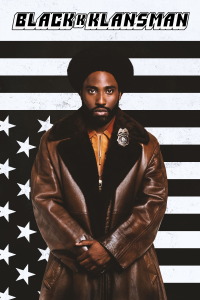
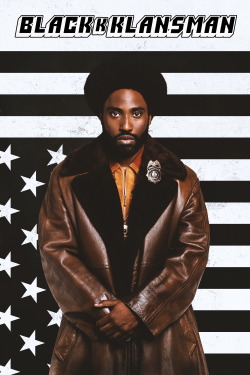
Telling the story of Rob Stallworthy (John David Washington), a black police officer in Colorado Springs who infiltrated the Ku Klux Klan in 1979, at its core, BlacKkKlansman is about institutional racism in the United States. Written by Spike Lee, Charlie Wachtel, David Rabinowitz, and Kevin Willmott, and directed by Lee, the film's second scene clearly signals its combative intent as well as highlighting its structural intricacy. The scene depicts the fictional cultural anthropologist Dr. Kennebrew Beauregard (Alec Baldwin), who, in grainy black-and-white footage tries to alert the audience to the fact that the negorids are attempting to take over the country. What's especially well done here is how Lee uses D.W. Griffith's The Birth of a Nation. As footage plays behind Beauregard, his face is erased of its colour - he is literally rendered white enough to become part of the image, which depicts a narrative built around the inherently virtuous nature of being white. It's a powerful shot that clearly tells us, yes, this is a comedy, and yes, these people are ridiculous, but also alerting us to the fact that Lee is not playing around here.
Lee again uses Birth in a later scene where it once more speaks to the formal complexity of the film. One of the most important of Griffith's innovations was parallel editing (known today as cross-cutting). In a nutshell, parallel editing is when two separate actions from two separate locations are intercut to suggest they are happening simultaneously, often, but not always, to heighten tension. However, Lee's genius in this scene is that he uses Birth to mock the Klan by way of, yep, parallel editing. As the KKK sit down to watch Birth, Lee intercuts them with Jerome Turner (Harry Belafonte) telling the story of the lynching of Jesse Washington, which saw a crowd of over 10,000 people in Waco cheering on as his testicles and fingers were cut off, after which he was slowly burned to death by being continually raised over a fire. Lee uses parallel editing here so as to have one scene comment on the other - he is literally using Birth's own innovations against it and what it represents.
But what is Lee's point? Simply put, he is condemning the cultural instability of the US in 2018, with its entrenched institutional racism, hateful rhetoric masquerading as national pride, the breakdown of the distinction between xenophobia and patriotism, and the transition of hate crimes from the fringes of society into the realm of social acceptability. The film suggests that organisational racism once existed half-way between the absurd and the dangerous, but in recent years, it has moved in the wrong direction. The closing montage, featuring footage of the Unite the Right rally and Trump's asinine response, drops all pretence of humour, and becomes very much a state-of-the-nation address.
All of this is not to say the film is perfect, however. For example, how he employs the double dolly shot (which he has used throughout his filmography to suggest characters' inability to control their own actions as they are inexorably pushed forward, divested of the contextualisation of their environment), suggests that orthodox black activism and underground black militancy must combine forces in the face of hate. The film also glosses over Stallworth's time in COINTELPRO, where he worked to sabotage radical black organisations. Additionally, a fictional explosion towards the end of the story serves to distastefully simplify everything, once more making the KKK look foolish, whilst also positing Stallworth as a clichéd movie hero, something Lee has avoided up until this point.
These are relatively minor complaints, however. Look, Lee is far from my favourite filmmaker, and he himself has been justifiably accused of racism on multiple occasions. None of that, however, changes the fact that this is an hilarious, powerful, insightful, and frightening piece of work.
This review of BlacKkKlansman (2018) was written by Bertaut1 on 02 Sep 2018.
BlacKkKlansman has generally received very positive reviews.
Was this review helpful?