Review of Black Sabbath (1963) by Blake P — 30 Mar 2016
The more Mario Bava films I consume the more I come to appreciate him. A horror filmmaker whose artistic valor was often sidelined with tiny budgets and minimally talented acting talents during his prime, some acclaim met him during his somewhat short career - several of his films were critical and commercial triumphs - but he, more or less, was not taken as seriously as he should have been by most studio personnel. His stylish "Planet of the Vampires" (1965) was saddled with such little money that, according to Bava, most of the set utilized just "a couple of plastic rocks ... left over from a mythological movie made at Cinecittà," a smoke machine compensating for the rest. 1966's "Dr. Goldfoot and the Girl Bombs" was, for American release, re-written, re-scored, and re-edited without Bava's cooperation; 1974's "Kidnapped" was kept from the public until 1998.
So with the resurgence in popularity toward Italian horror (the giallo subgenre is a particular favorite of mine), I'm glad that Bava is finally getting the small-time recognition he so heartily deserved during his lifetime. Sure, his clunkers clunked, and he was more talented of a visual storyteller than he was an actual storyteller. But one can wonder what might have happened to several of his finest works had cinephiles not unearthed them from their dusty graves - would they have forever been passed along as B-movies with an eye for style?
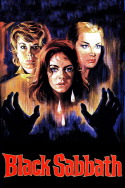
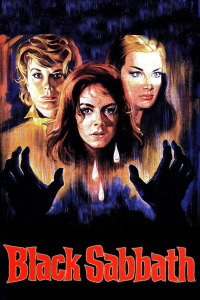
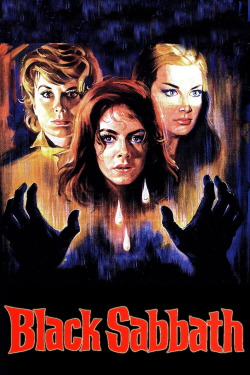
Perhaps not; his best films are too optically striking to be forgotten. One of them, 1963's "Black Sabbath," is an anthology of phantasmagoric horror stories uneven in stature but notwithstanding visually flavorsome. With three short stories defining its running time, campy Boris Karloff introductions commencing the beginning and end of each piece, "Black Sabbath" is a work of unsettling macabre combined with ghost story playfulness. Though it never quite meshes together as well as we'd like it to - such is a problem with movies made of vignettes - the film has long stretches and flashes of horrific brilliance that only Bava could have helmed.
Versions of the film differ. I presume that I viewed the American release, which changes the original order of the stories and censors some sexual undertones. But these minor tweaks hardly deter Bava's vision; his trademark, grisly spookiness is at its very best.
The first tale of terror in "Black Sabbath" is 'A Drop of Water,' the most original of the three and certainly the most terrifying. It stars Jacqueline Pierreux as Helen Chester, an English nurse called to the home of an elderly clairvoyant who has recently died. Needed for casket preparation, Helen is tasked with gussying up the body before burial. As it's late at night and the body itself looks like something straight out of a - gasp - horror movie, Helen gets the job done as quickly as she can, uncomfortable being in the presence of such an unnerving corpse. But a sapphire ring adorning the finger of her dead client captures her eye. She steals it, figuring the medium won't miss it. Turns out, the latter might.
The next story, 'The Telephone,' is the weakest of the trio, a seen-it-all-before spin on "When a Stranger Calls" territory as stale as it must have been in 1963. The beautiful Michèle Mercier portrays Rosy, a (never explicitly stated) call girl being terrorized by phone calls from her pimp, whom she thought to be dead. But most of our being isn't so concerned with such matters; most of the vignette is too cutout to draw out any sympathy, though the claustrophobia is palpable, and I like the twist ending.
"Black Sabbath" closes with the atmospheric 'The Wurdalak,' a tale of vampirism that benefits from a surprise appearance by Karloff, who we had originally believed to simply be the anthology's host. It concerns a family tormented by the titular beast, which is a living cadaver only able to feed on the blood of loved ones. Things are complicated by Vladimir (Mark Damon), an outsider who stumbles upon the family home at their most vulnerable time.
If anything, "Black Sabbath" is more style than substance, but as long as Bava's the man in charge of the patina, I'm perfectly fine with such setbacks. All that matters is that a ghostly ambience is kept intact and believable, and "Black Sabbath" is more than successful in conjuring up frights. Bava's ocular richness is enough to hypnotize us, so it's a good thing that the film matches his wondrous artistry - one isn't a director, writer, and cinematographer for nothing.
This review of Black Sabbath (1963) was written by Blake P on 30 Mar 2016.
Black Sabbath has generally received positive reviews.
Was this review helpful?