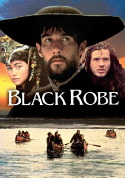
Review of Black Robe (1991) by Edith N — 16 Apr 2011
Seeking Martyrdom in the Great White North.
I may very well be this film's intended audience. I know a fair amount about the historical period under consideration, and I appreciate quality cinematography. I'm willing to put up with spirituality and symbolism. I don't expect a happy ending from this kind of story--or indeed an ending. Roger says it seems, with the addition of the title card at the end, to be a prelude to nothing, and the fact is, he's right. Which I thought was rather the point. I don't think people are really aware of the horrific attrition rate suffered by pretty much everyone in the early days of European colonization in the Americas. It's estimated that ninety percent of the native population died of disease, generally smallpox, after colonization. But what people may not realize is that the Europeans basically seemed to go to the New World to die. Only fifty-three passengers of the [i]Mayflower[/i] celebrated that first Thanksgiving, including only four adult women.
One of the things the Europeans were doing in the New World was Converting the Heathen, generally whether they wanted to convert or not. Young Jesuit Father LaForgue (Lothaire Bluteau) is being sent from Quebec to a mission to the Huron, deep in the wilderness. He is being led there by a group of Algonquin. Their leader, Chomina (August Schellenberg), takes his wife (Tantoo Cardinal) and daughter, Annuka (Sandrine Holt), along, and Daniel (Aden Young) goes along with Father LaForgue. Daniel and Annuka fall in love. We learn that LaForgue's mother (Marthe Turgeon) believes that he will be martyred in the wilderness. Chomina is having dreams of his people dead and the Black Robe walking alone. His wife tells him that he should trust his dreams. The shaman of another tribe encourages him to leave the white men to die, and Chomina reluctantly goes along. But when Daniel abandons LaForgue to seek out Annuka, Chomina's guilt sends him back to get LaForgue, which doesn't turn out to be the best decision for him.
I have to admit that I took perhaps a little too much pride in spotting the anachronism in this movie, and that's where my Catholic background comes in. LaForgue's mother is shown in flashback praying before he leaves for New France. She asks her son the priest to pray for her; so far, so good. But he comes across her praying before a statue of "Saint Joan." Except she wasn't, yet. She wasn't canonized until 1920. This is in theory not that big a deal, and I'm pretty sure the rest of the movie is better researched. However, Saint Denis would have been more accurate, or maybe Saint Martin of Tours. Saint Denis would have been better, though, because he was also martyred. On the other hand, the average modern audience who wasn't raised Catholic--or, presumably, French--wouldn't necessarily realize that Joan wasn't a saint yet and probably wouldn't have heard of Denis.
As it happens, the patron saint of Canada, Saint Jean de Brébeuf, was a martyred Jesuit. During the events alluded to at the end of the film, in fact. I'd even argue that his death manages to validate some of the violence in this movie, which Mohawk groups have complained about. It's true that the Mohawk are the Bad Guys. It's also true that they would not have been likely to kill Chomina's son, whose name I missed, since he was young enough to have been adopted instead. Likewise, burning Annuka at the stake seems unlikely. They adopted women, too. However, the Iroquois did battle the Huron. I've little doubt that a movie shown from the Mohawk perspective wouldn't exactly paint the Huron in the best of lights, either. And honestly, you could pretty much pick any group in the Americas at that time and write one story which showed them as slaughtered and one which showed them as slaughterers. If Chomina and his men had gotten any of those Mohawk home, it would not have ended with Algonquins seeing the She-Manitou (LinLyn Lue).
Canada in the winter, even relatively southern Canada, isn't exactly a place of warmth and golden light. However, neither is the soul of Father LaForgue. Chomina tells him that he should not wish for death, though I think that's at least in part because he thinks LaForgue's Paradise sounds very boring. As it happens, it does to young Daniel as well. The two men seem to represent differing perspectives on the natives from the European settlers. Daniel sees their lives as being mostly peaceful, the kind of One With the Land image which has come down to us through the centuries. LaForgue wants to shape the natives' lives in the Europeans' image. He really does believe that they are ruled by the Devil, that only by accepting Jesus as their one God can they be saved from the fires of Hell. But that also means that their entire way of life, which is opposed to the Bible's teachings, must be changed. That, as much as disease, is what spelled doom for many converts.
This review of Black Robe (1991) was written by Edith N on 16 Apr 2011.
Black Robe has generally received positive reviews.
Was this review helpful?