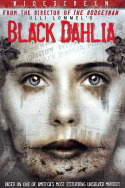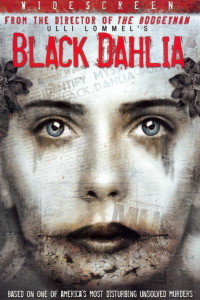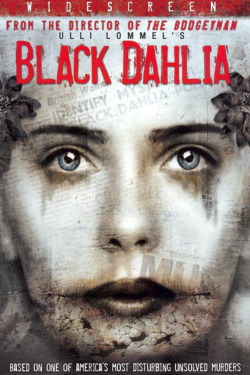
Review of Black Dahlia (2006) by Jeremiah Z — 16 Sep 2009
Another Woman Trapped by Her Death.
There are many solutions to the case of who killed poor Elizabeth Short. One woman wrote a book accusing her own father of the crime; the solution here involves, I think, entirely fictional characters and therefore cannot be taken seriously. Even if they aren't, even if they are based on real people, there's a heck of a lot of speculation involved in the story. Elizabeth Short, for example, while she claimed to have done screen tests for all the major studios, cannot be shown to have done so. An important aspect of the story here seems to be the main detective's falling in love with the woman onscreen, the woman in all those screen tests. His obsession stems from that. And, frankly, I don't think that's necessary. I think it's another attempt the film makes to create a psychological thriller that just doesn't have the power behind it.
Dwight "Bucky" Bleichert (Josh Hartnett) is a cop in LA. Because he's a decent boxer, he gets put in a publicity match with fellow cop Lee Blanchard (Aaron Eckhart) which somehow gets an initiative passed to provide more money to the police department, I'm not sure how, and the publicity involved also gets him a promotion to the homicide squad. Somehow. And then, poor Elizabeth Short (Mia Kirshner) is found dead in a field, tortured and mutilated. Essentially all anyone has ever been able to prove is that she wasn't killed on the spot, and that's really not enough to base a case off of. However, Blanchard gets obsessed with the case, and Bucky gets pulled in--along with Blanchard's girlfriend, Kay Lake (Scarlett Johansson). Bucky gets entangled with Madeleine Linscott (Hilary Swank) and her mad dysfunctional family. The story of Elizabeth Short is a shadow over the whole thing, and everything everyone does is influenced by her, leading to one of the most bizarre denouements I've seen in a long time.
The setting of the movie is fine. It looks period-appropriate, for all I'm not sure the elaborate lesbian bar with the elaborate production number really works. (Nice cameo by k. d. lang, though.) Still, I think it's a little too self-conscious of its own stylishness, which actually may have the lesbian bar as a symptom. I'm aware that the lesbian underworld in the Los Angeles of the '40s was not quite what we think of when we think of gay underworld now, but it still seems a little much. There's a scene with Hartnett and Swank in bed together, and he's still honest-to-Gods wearing his hat. She's wearing her pearls, too. It's a little too self-consciously sepia toned. In the making-of on the DVD, the costume director tells us happily how she colour-coded Hartnett's shirts for our convenience. I do like, on the other hand, that he doesn't wear a lot of different clothes. Even Hilary Swank, who plays a rich girl, wears one dress at least twice.
Another major problem for me is the casting. As we've established, I've decided that I really don't think Scarlett Johansson can act. On the other hand, she can still act circles around Josh Hartnett, who has all the dynamic personality of a block of wood. Aaron Eckhart and Hilary Swank are both very talented--Swank does have that pair of Oscars, after all, and Eckhart's performance in [i]The Dark Knight[/i] is only commented on so little because it's so totally overshadowed by Heath Ledger. However, they both feel horribly miscast, and Eckhart's frankly chewing the hell out of the scenery in several of his scenes. Though even there, he can't touch Fiona Shaw as Ramona Linscott, Swank's character's mother. Most of the cast is wrong for their roles in one way or another, frankly, except for that lovely, lovely Mia Kirshner as the vulnerable Elizabeth Short.
A month or so ago, [i]Newsweek[/i] ran a cover about the American obsession with true crime. Their main focus was the fact that we're still talking about poor Sharon Tate forty years after she died, but I think even there, there's a hint of what tends to fascinate us most. Elizabeth Short and Sharon Tate were both beautiful women. Jack the Ripper has become such a historical obsession, I think, because he killed women--and since we've only ever seen them dead, we can imagine them as young and fresh and beautiful in life, in the face of all the evidence. There is also, in the cases of both the Dahlia (and no, no one really knows why she was called that) and the Ripper, the aspect of a story untold. Who killed Elizabeth Short, that beautiful young girl, that struggling actress, that possible prostitute? We don't know; we will probably never know. And isn't it more interesting that way?
This review of Black Dahlia (2006) was written by Jeremiah Z on 16 Sep 2009.
Black Dahlia has generally received negative reviews.
Was this review helpful?