Review of Bite the Bullet (1975) by John H — 07 May 2010
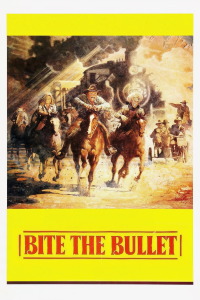
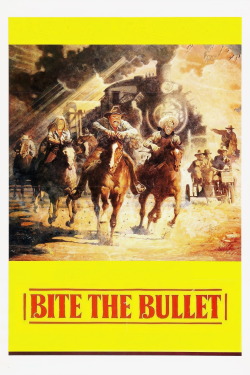
"Blackboard Jungle" director Richard Brooks made three westerns during his long, forty-three year career in Hollywood. This rugged, liberal-minded, turn-of-the-century oater about an arduous 700 mile horse race through scenic but inhospitable terrain was his final sagebrusher. Brooks derived his screenplay from an actual historic event, the 1908 cross-country horse race from Evanston, Wyoming to Denver, Colorado, that the Denver Post sponsored with a $2,500 purse to the victor. Brooks does a fine job of assembling his sturdy, all-star, ensemble cast, with Gene Hackman and James Coburn playing leathery tough old pals who fought together under Teddy Roosevelt in Cuba. "You start trouble," Coburn quips after their first fistfight with several rowdy cowboys in a stable, "and I start bleeding." Essentially, this is a horse-friendly, competitive, sports western. The atmospheric, color cinematography is majestic, and some of lenser Harry Stradling's photography is exceptional, especially the way he integrates regular speed shots with slow motion as one horse gallops at regular speed runs alongside another one in slow-motion.
The first three-quarters of the narrative concern the race itself and the participants. Afterward, the action alternates between the horse race and the checkpoints where the characters pause to convey relevant exposition about themselves. The vintage steam engine train constantly chugs in and out of the story. The last twenty minutes deals with a prison break. Had Brooks not foreshadowed this part of the narrative, it would have looked like a last minute digression to from the main plot. Alex North's flavorful orchestral score received an Oscar nomination as did the collective efforts of Arthur Piantadosi, Les Fresholtz, Richard Tyler, Al Overton Jr., in creating a sound design. Brooks also dwells on the theme of cruelty to animals and his spokesman who advocates the humane treatment of horses is the Gene Hackman protagonist who is first seen rescuing a colt from coyotes. The colt is chained to a shattered wagon that belongs to the Tip-Top Glue factory. Brooks also takes a swipe at racial intolerance in the form of the prejudice shown toward a Mexican vaquero who is ridiculed by some secondary characters. Our hero Sam Clayton is quick to come to come to the vaquero's defense with a story about his Hispanic grandfather that he bathed everyday and on whom he never found a greasy spot.
The race has two rules. First, no horse can carry more than 160 pounds, including rider, saddle, and extras. Second, the race coordinators have provided each horseman with a compass and a map with the safest route. They don't have to follow the safest route, but they must make it to each checkpoint or they will be disqualified. Mario Arteaga elicits sympathy as a Mexican horseman with a toothache. During a barroom scene, the woman serving the liquor gives the Mexican a new-fangled concoction designed to kill pain: heroin. Technically, just as Sergio Leone broke new ground in "For A Few Dollars More" with a marihuana puffing bandit, Brooks breaks ground with the use of heroin.
Candice Bergen furnishes the female interest as Kate Jones, a hard-luck prostitute after the $2-thousand prize money. Kate has more at stake as we later learn when Brooks takes a break during the last twenty minutes from depicting horses galloping through deserts, wading streams, and tangling with bears. The heroine wants to break her no-good, bank robbing husband Steve (Walter Scott, Jr., of "Cotton Comes to Harlem") out of prison. After she does, she realizes what a terrible mistake that she has made. Brooks ties this to the theme of bad marriages, and our mustached protagonist Sam Clayton (Gene Hackman of "Bonnie and Clyde") sums up the problem in one phrase: "The people some people marry." Veteran western character actor Ben Johnson turns in another meaningful performance as a supporting character suffering a bad heart condition that eventually claims his life. During his dying moments, he delivers an eloquent as well as insightful soliloquy about the essence of winning. Not only does Brooks have a Mexican character, but he also has a cultivated Englishman, Sir Harry Norfolk (Ian Bannen of "Too Late, The Hero") who has crossed the Atlantic to compete in the race.
Incredibly enough, Jan-Michael Vincent has the plum role as Carbo, an obnoxious, immature adult who likes to display his prowess with fists and six-guns. Actually, Carbo turns out to be no cowboy after all, and the revelation that everything that he has done to perpetuate this masquerade that he is a cowboy lends more depth and substance to his character than even the standard-issue heroes that Hackman and Coburn portray. Kate informs Carbo late in the last half-hour that she never believed that he was a cowboy. She explains that a cowboy undresses from the boots up and only removes his headgear after he has stripped off everything. Unable to resist a joke, Brooks shows Hackman and Coburn's characters eavesdropping on her speech and noticing that they still have their hats on after they have shed virtually every stitch of apparel.
Naturally, the dialogue is as quotable as it is philosophical as Brooks ponders the meaning of being an American. Everything boils down to winning and the recognition that comes with winning. The Hackman hero worries that he is un-American because he has no interest about who won a champion boxing match. Brooks cannot resist debunking the Old West and the Hackman hero becomes his mouthpiece. Former Roosevelt rough rider Sam Clayton reminiscences in one scene with Kate about the lies told about the San Juan Hill charge. Later, the Dabney Coleman character complains that most of what is said about the west is a lie. Nevertheless, this memorable dialogue doesn't surpass Brooks' second western, the elegiac oater "The Professionals." "The Professionals" ranks as a far better film, more robust and exciting. Indeed, aside from Michael-Vincent's character that changes near the end of the action, the only surprise in "Bite the Bullet" is the ending.
This review of Bite the Bullet (1975) was written by John H on 07 May 2010.
Bite the Bullet has generally received positive reviews.
Was this review helpful?