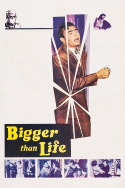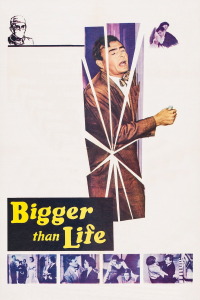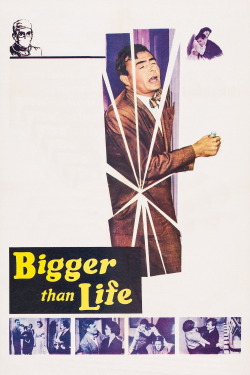
Review of Bigger Than Life (1956) by John R — 01 May 2010
What happens when a person tamps down all of their hopes and dreams in an effort to conform to the wishes of others and do the right thing by socially accepted standards? A certain dullness from repetition creeps in, and perhaps they have to extend themselves to keep up with the rest, especially if their salary is modest.
But then what happens when all those hopes and dreams and impulses are suddenly released, catalyzed by an outside agent, such as a drug? The side effects can be out-sized, and the shadow cast by those effects will tell us what and where that person has held themselves back, and the true price they may be paying.
It's a stark film, filled with buried humor and expressionistic flair, and imbued with the straight-on and slightly-skewed critique that came through Nicholas Ray, in his films and person. Not all is perfect, but in lots of ways many aspects of the film are, and the overall effect, while painting a dark picture that requires the hardly-happy happy ending to truly achieve it's criticism, it does offer lots to reflect on of great value.
It's a clear portrait of where not to go and what not to do, and as always, the way through is not always easy, and even after the door is glimpsed some do not take the chance. Stunning to see this in the 50s, but the 50s was the hangover, the return to enforced social order and the buckling that proceeded from it.
Have things changed today? We'd be arrogant to think so. Beautiful looking movie with great performances all around, and while James Mason is the centerpiece, he modulates and pulls off the Everyman quite effectively, blending admirably with Barbara Rush and Walter Malthau.
Christopher Olsen is a stand-out as Mason's son.
This review of Bigger Than Life (1956) was written by John R on 01 May 2010.
Bigger Than Life has generally received very positive reviews.
Was this review helpful?