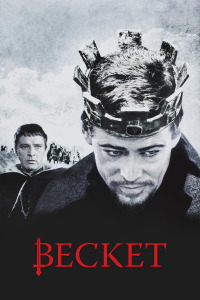
Review of Becket (1964) by Cameron J — 26 Aug 2014
"Bend it Like Becket"! I stretch, but Beckett Media is a sporty publication, although this film is much older than David Beckham himself, so the pun still falls ferociously flat. On top of all that, this is a religiously-charged historical epic based on a French play, so it's anything but sporty. Well, at least it's less cheesy than "My Fair Lady", and while that isn't to say that "My Fair Lady" isn't good, it is to say that this film shows why the Golden Globes has a Best Musical category, because you'd think that the Oscars would be all over this. In 1963, the Golden Globes, not simply nominated, but awarded "The Cardinal" Best Picture-I mean, Best Drama, and in 1964, this film took home that same sort of bacon that the Catholics are actually allowed to enjoy, so for a while there, the Jews who undoubtedly make up much of the Hollywood Foreign Press Association were getting into Catholicism. One does have to give these two films credit for figuring out how to make subject matters dealing with Catholic archbishops interesting enough to be the basis for epics which, well, are still of varying intrigue. Hey, "The Cardinal" was compelling, and this film is pretty good, too, although it stands to be tighter, and more original, for that matter.
As a '60s period melodrama set in olde England, this film could have been either unique or formulaic, and it ultimately falls somewhere in between, having some refreshing elements, in addition enough derivative aspects to be rather predictable, anchored by familiar character types who actually stand to be more recognizable. Immediate background development is a little lacking, making the unlikable traits of the leads fairly glaring, and although gradual exposition is plentiful, the performances are more nuanced than the characterization whose degree of depth is inconsistent, but generally somewhat thin, as a supplement to the melodrama more than the humanity. Melodramatics are certainly unavoidable in this adaptation of a stage interpretation of 12th century English affairs of political, religious an human natures, and storytelling is generally sound enough for you to buy into the histrionics, but their familiarity makes it easier to feel their contrivances, which aren't even extreme enough to really flare up the intrigue. This olde English romanticism is no longer relevant and is plenty dry, and it would be embraced more if it wasn't overplayed in the form of minimalist dialogue, with plenty of dramatic weight, but little action behind it to reinforce a sense of consequence, and keep momentum going. As things stand, there's something kind of flat about the direction in certain places, for although there is enough inspiration to the storytelling and acting within this intimate drama to keep entertainment value adequate through sound intrigue, when kick falls, you really can't help but feel the length of this talkative and wandering affair which runs two-and-a-half hours. The film is a little too long to not have much go on, and with considerable competence, it engages through and through, though one's investment just has to be challenged by moments of familiarity, expository shortcomings, melodramatics, and pacing issues which threaten the final product's reward value. This reward value is ultimately near-firmly secured, because as much as the film tries your patience, it engrosses more often than not, at least aesthetically.
Actually, the aesthetic value of this film isn't especially outstanding, but it is solid enough to play some respectable role in reinforcing engagement value, with Laurence Rosenthal turning in a conventional, but grand score, while Geoffrey Unsworth's cinematography carries enough sweep to its lensing to make up for some shortage of flare to relatively briskly defined lighting and coloration. Unsworth's grand eye at least gives you a well-rounded feel for Maurce Carter's art direction, whose orchestration of John Bryan's production designs and Margaret Furse's costume designs sells the time both lavishly and realistically, and therefore playing an instrumental part in immersing you into this melodrama which thrives on its intimacy. Sure, the intimacy of this drama minimalizes the scope of this pseudo-epic, making it hard to deny the excessiveness of the two-and-a-half-hour-long runtime, just as conventional occasions and moderate underdevelopment make the histrionics harder to deny, and yet, this study on how great men of a romantic time interpreted politics, religion, peasants, each other and, most of all, themselves is thematically rich, with high intellectual and dramatic potential to be done justice. Peter Glenville's direction has flat spots to really slow down momentum, but where it could have been drier and duller, its thoughtfulness falls over enough consistent dramatic material to carry a subtlety and grace that draw upon the intellectual value of this melodrama, broken up by resonant moments of delicate tension which secure the engagement value of the directorial storytelling. I suppose Glenville's direction doesn't hit quite as many missteps as Edward Anhalt's writing, although this script may do a greater justice to Jean Anouilh's classic story than the directorial storytelling, rich with glowing dialogue to sustain entertainment value through all of the overt chit-chat, while characterization manages to be just meaty enough for nuanced performances to compensate for expository shortcomings. Indeed, if nothing else makes this character melodrama so compelling, it is the across-the-board strong performances in a gifted cast, from which the leads stand out, with Richard Burton being unevenly used, yet consistently engrossing in his subtle, convincing portrayal of a man of sophistication and faith who respects and challenges the questionable aspects of a loving king, while Peter O'Toole steals the show in his dynamic, intense portrayal of a man of great power and corruption who is initially charismatic in his sleaze, but grows to be a wreck when his humanity is stressed to him through betrayal and a fear of his own mortality. These two leads and their electric chemistry are the heart and soul of this intimate epic of little dynamicity, but considerable intrigue, driven by inspiration on and off of the screen which make the final product a rewarding trial for one's patience.
In conclusion, there are occasions of conventions and some unevenness to the depth of characterization, while melodramatics keep too consistent to be ignored in the draggy telling of an intimate story of limited urgency, but through grand score work and cinematography, immersive art direction, sophisticated direction and writing, and effective performances, - the most powerful of which being by the solid Richard Burton and the outstanding Peter O'Toole - Peter Glenville's "Becket" rewards as an intimate portrait on the conflicts between men of religion and humanity and men of royalty and corruption.
3/5 - Good.
This review of Becket (1964) was written by Cameron J on 26 Aug 2014.
Becket has generally received very positive reviews.
Was this review helpful?